

Preschool readiness milestones are the play, language, social-emotional, and motor skills most children can do by ages three to five, and the CDC frames them as things at least 75% of kids manage by a given age. Here is the surprising part for parents Googling this at 10pm: teachers weigh whether your child follows directions and gets along with peers far above whether she knows her letters. This guide walks the real benchmarks, and how to support them tonight.
Key Takeaways
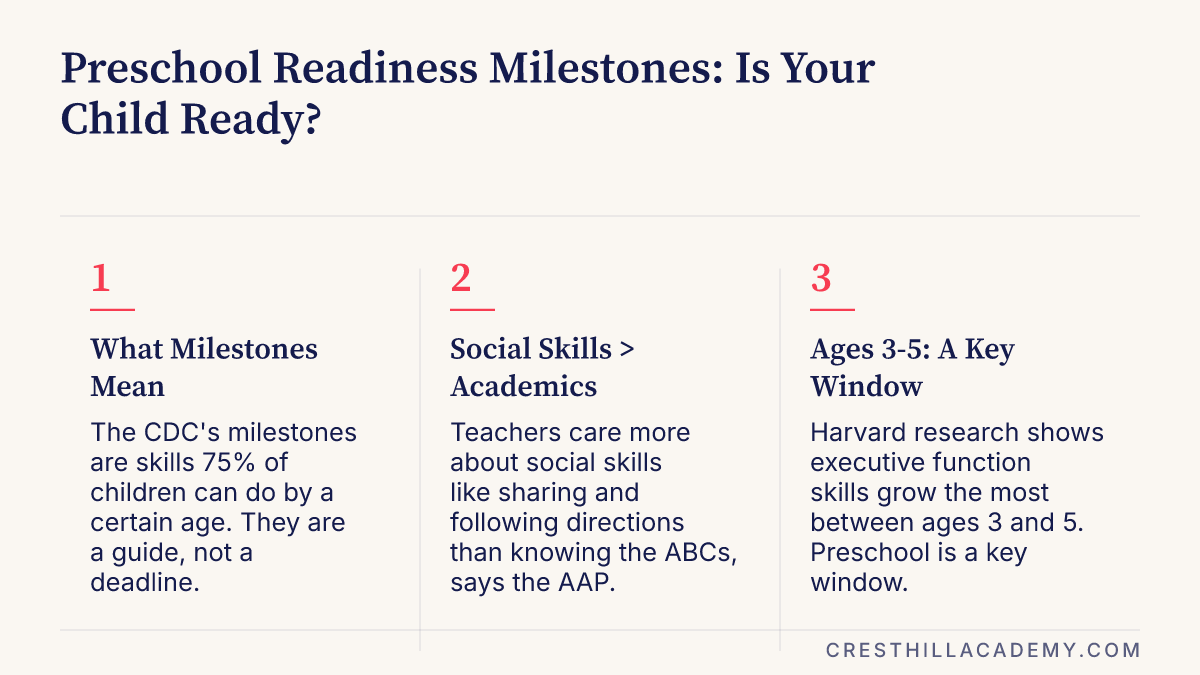
- Milestones are a 75% benchmark, not a deadline: The CDC defines developmental milestones as skills most children (75% or more) can do by a given age across how they play, learn, speak, act, and move.
- Social skills outrank the alphabet: The AAP notes teachers care most about a child's social skills and ability to follow directions and get along with others, not pre-academic knowledge.
- Ages 3 to 5 are an executive-function window: Harvard's Center on the Developing Child reports executive-function skills grow dramatically between ages three and five, making preschool a critical developmental window.
What Do Preschool Readiness Milestones Actually Measure?
A developmental milestone is not a deadline. According to the CDC, milestones are the skills most children (75% or more) can do by a certain age. They span five domains: how a child plays, learns, speaks, acts, and moves. That 75% framing matters because it builds in the wide, normal range every real classroom contains.
The CDC revised its milestone checklists in 2022 with the American Academy of Pediatrics, shifting from the old “50% of children” threshold to the clearer 75% mark. That change was deliberate. Researchers wanted to reduce the “wait and see” delays that kept families from acting when a skill lagged. So the modern chart is designed to flag concerns sooner, not to raise the bar on average kids.
Notice what the framing leaves out. Not one of those five domains is “knows the alphabet.” Readiness is a whole-child picture: physical well-being, social-emotional maturity, self-regulation, language, and thinking skills braided together. ZERO TO THREE puts it plainly, that school readiness begins at birth and rests on language, literacy, thinking, and social-emotional foundations.
So a milestone chart is a guide for you, not a report card for your child. Some four-year-olds speak in long paragraphs but wobble on one foot. Others scale the playground fearlessly and stay quiet at circle time. Both patterns sit inside the normal range. Our teachers see this every September, and here is how we read it: the point is to watch the whole arc of growth, celebrate each new skill, and notice where a little extra support helps.
Milestones describe; brain development explains
Understanding how these skills stack over the earliest years gives the milestone chart context. If you want the full birth-to-five picture, our overview of development milestones ages 0 to 5 maps each stage, and our look at child brain development birth to age five explains the wiring underneath the behavior. Milestones describe what you see; brain development explains why it shows up when it does. A child does not “decide” to sequence a story at four; the neural circuits for working memory simply come online, and rich experience shapes how fast.
Why Do Teachers Weigh Social Skills Over Academics?
Ask a preschool teacher what she hopes to see on day one, and she rarely says counting. The American Academy of Pediatrics says the same at the level of policy. School readiness, per the AAP, is not just about pre-academic skills. It is a combination of physical well-being, social-emotional ability, self-regulation, language, and cognition that begins at birth.
The five-year checkup tells the story. At that visit, the AAP notes, academic skills matter, but teachers are most concerned about a child’s social skills and language. Getting along with other children and following directions are described as extremely important for school readiness. That is a pediatric authority ranking cooperation above the alphabet.
There is a mechanism here, not just a preference. A child who can wait a turn, ask for help, and recover from a small frustration can actually access instruction. Compare the child who arrives at circle time dysregulated, bright as she may be: a phonics lesson slides right past her. Self-regulation is the gate; everything academic passes through it. In our own rooms, we front-load emotion coaching for a reason. A settled child is a child who can learn.
The research backs the ranking. A widely cited 2015 study in the American Journal of Public Health, drawing on nearly 800 children followed for two decades, found that kindergarten social-emotional skills predicted adult outcomes in education, employment, and mental health. Kids who shared, cooperated, and helped peers were more likely to finish college and hold steady jobs. Early cooperation, in other words, is not soft. It forecasts hard outcomes.
This is also why the AAP calls the flat “ready or not ready by age four” idea controversial. Readiness is a stage, not a switch. If you want the research on why these capacities carry so much weight, our piece on why social-emotional learning matters in early childhood unpacks the evidence and the everyday practices that build it. Across our preschool rooms, the fall arc is telling: September brings tears at drop-off and parallel play; by spring the same children are negotiating roles in a pretend bakery, one running the register, another insisting the muffins need to cool first. That growth is the curriculum, not a distraction from it.
Which Milestones Show Up Between Ages 3 and 5?
Here is where the abstract framing gets concrete. The CDC’s preschooler guidance names skills most children reach in this window. Preschoolers begin to help dress and undress themselves. They can recall part of a story. They sing songs. Crucially, they grow more independent and start focusing on adults and children outside their own family.
Self-help and independence. The dressing milestone is a big one, and it is easy to observe at home. A three-year-old might pull on loose pants; by four, many manage a jacket zipper with a running start. By five, buttoning and tying often start clicking into place. These are not just motor feats. Every self-help win builds the confidence a child carries into a classroom full of new demands, and it frees teachers to teach rather than manage coats.
Language and memory. Recalling part of a story signals working memory and sequence, the same machinery reading will later lean on. Vocabulary explodes in these years, from roughly 1,000 words at age three to several thousand by five, according to the American Speech-Language-Hearing Association’s communication milestones. Singing songs delivers rhyme and phonological awareness in a package that feels like pure fun. Reading Rockets notes that rich stories and real conversation strengthen oral language, which eventually makes children better readers.
The social shift is the quiet headline. A child turning her attention toward peers and unfamiliar adults is practicing the exact skill teachers prize. Watching, then joining, then cooperating is the arc of early friendship. It looks like play. It is serious developmental work. By four, most children move from parallel play, playing near a peer, to genuine associative and cooperative play, building a shared block city with assigned jobs.
Fine motor skills quietly gather in these years too. A three-year-old grips a crayon in a fist; a five-year-old often holds a pencil in a tripod grasp and copies a square or triangle. Cutting along a line with scissors, threading beads, and drawing a person with a head, body, and limbs are all in-window skills that feed handwriting later. These small-hand feats matter as much as the loud playground ones.
For a year-by-year breakdown you can check against your own child, our development milestones ages 0 to 5 guide lays out each age, and when the horizon is the next school year, our kindergarten readiness guide extends the picture. The table below sorts the preschool-window milestones by domain so you can scan them fast.
| Founded | 2010 |
|---|---|
| Locations | 8 |
| Programs | 3 |
| Curriculum | EsteamED Curriculum |
| Curriculum pillars | 8 |
| Key features | 12 |
| Audience | Northern New Jersey families |
| Source | cresthillacademy.com |
How Does Executive Function Grow During the Preschool Years?
Executive function is the brain’s air-traffic control: the skills that let a child hold information in mind, resist a first impulse, and shift attention when the plan changes. Harvard’s Center on the Developing Child reports that these skills begin developing shortly after birth, with ages three to five a window of opportunity for dramatic growth.
Three core skills. Executive function bundles working memory (holding a two-step direction long enough to act), inhibitory control (waiting for a turn instead of grabbing), and cognitive flexibility (switching from paint to cleanup without a meltdown). These are the everyday muscles of a functional classroom, and they strengthen through use, not lecture.
Because the window is wide open at these ages, ordinary play does heavy lifting. A game of Simon Says trains inhibitory control. Sorting blocks by color, then re-sorting by shape, trains flexibility. A pretend restaurant where the child holds an “order” trains working memory. None of it looks like schoolwork, which is exactly why children stay engaged long enough to grow.
The marshmallow test, revisited
The famous Stanford “marshmallow test” is the classic executive-function story: children who could wait for a second treat tended to fare better years later. Newer research complicates the headline, showing that a child’s home environment and stability explain much of the effect. That nuance is useful for parents. Self-control is not a fixed trait a child has or lacks; it is a skill that grows in predictable, supportive routines. A child who trusts that a promised turn will actually come learns to wait. We watch that trust build week by week when the sand timer at the water table always means what it says.
Executive function and social-emotional skill reinforce each other. A child who can pause an impulse also handles a disagreement better; regulation and reasoning grow together. Our explainer on child brain development birth to age five shows the wiring, and why social-emotional learning matters in early childhood connects that wiring to daily behavior.
Do Sleep and Screen Habits Affect Readiness?
Two everyday habits shape whether a child can access the skills above: sleep and screens. The AAP, through HealthyChildren.org, recommends preschoolers ages three to five get 10 to 13 hours of sleep per 24 hours, naps included, and limit screens to no more than one hour a day of quality programming. Both numbers are load-bearing, not lifestyle suggestions.
Why the numbers matter. Sleep is when the developing brain consolidates memory and resets self-regulation. A short-slept preschooler runs low on the exact executive-function fuel that circle time demands. Studies link insufficient sleep in young children with more attention problems, weaker emotional control, and slower language growth. A missed hour of sleep does not just make a child tired; it taxes the very systems readiness rests on.
Screens compete directly with the face-to-face interaction that builds language and emotion-reading, which is why the one-hour ceiling protects developmental time rather than merely limiting fun. Research on “technoference,” background screens interrupting parent-child talk, shows that fewer conversational turns mean fewer chances to grow vocabulary. The issue is less the screen itself than the rich human exchange it quietly displaces.
The practical move is substitution, not just subtraction. Trade a second show for open-ended play, and both the sleep and the screen targets get easier to hit. A consistent wind-down routine, dim lights, a bath, two books, matters more than a strict bedtime clock. For ideas that fill the gap, see our list of screen-time alternatives and activities, and for the research on why the ceiling exists, our reporting on screen time linked to atypical sensory processing behaviors is worth a read.
How Can Parents Track and Support Milestones at Home?
Worksheets are not what builds readiness. Routines and free, credible tools are. The CDC offers a free Milestone Tracker app that shows what to watch for at each age and helps you organize questions before a checkup. Tracking is not a competition; it is a way to celebrate progress and catch a concern early.
A simple home playbook. Build independence by letting your child pull on shoes, wash hands, and put toys away, even imperfectly. Grow language by reading rich stories and talking through the day in real back-and-forth. Coach emotions by naming feelings out loud: “It looks like you’re frustrated the tower fell.” Small, daily, repeatable. That is the whole method.
Play is the engine. Counting stairs, squishing playdough to build hand strength, and singing rhymes deliver math, fine-motor, and literacy practice inside activities children already love. The “serve and return” of everyday conversation, you say something, your child responds, you build on it, is one of the most evidence-backed ways to grow a young brain. Our roundup of play-based preschool activities for toddlers turns this into a ready-made rotation you can start this week.
Free screening tools worth using
Beyond the CDC app, the Ages and Stages Questionnaires (ASQ) is a research-backed screener parents can complete in about 10 to 15 minutes, covering communication, motor, problem-solving, and social-emotional skills. It is not diagnostic, but it organizes what you are seeing into something concrete to share. Many pediatric offices already use it at well visits, so completing one at home means you walk in with matching language. Pair it with the age charts in our development milestones ages 0 to 5 guide, and you have a clear, low-stress tracking system. At Cresthill Academy, the EsteamED Curriculum builds these same domains into daily play across our infant, toddler, and preschool rooms, and our lead teachers share their observations with families so home and classroom stay aligned.
When Should You Talk to Your Doctor?
Trust your instincts, and do not “wait and see.” The CDC’s guidance is direct: if a child is not meeting one or more milestones, has lost a skill, or you simply have a concern, talk with the doctor and ask about developmental screening. Acting early opens support during the window when it helps most.
The screening schedule. The AAP recommends standardized, validated developmental screening at 9, 18, and 30 months, plus autism-specific screening at 18 and 24 months, or any time a parent or provider has a concern. Bring specifics to the visit. “He is two and a half and uses about 20 words” gives your pediatrician far more to work with than “I’m worried about his speech.” Early intervention services, funded in every state, are most effective when they start young, while the brain is most plastic.
Some specific flags deserve a prompt call rather than a watchful pause. By age four, a child who cannot jump in place, scribbles rather than draws, ignores other children, or is hard for strangers to understand warrants a conversation. So does any loss of a skill she once had, which the CDC treats as a red flag at any age. None of these guarantee a problem; they simply earn a professional look.
Regression deserves special attention. If a child loses a skill she once had, mention it promptly, along with any relevant history such as prematurity. You can also request a free evaluation through your local public school under “Child Find,” no doctor’s referral required. That right exists under federal law, and you do not need to be enrolled to use it. For the milestone benchmarks that anchor these conversations, keep our development milestones ages 0 to 5 guide handy.
Frequently Asked Questions
What Do Preschool Readiness Milestones Actually Measure? A developmental milestone is not a deadline. According to the CDC, milestones are the skills most children (75% or more) can do by a certain age. They span five domains: how a child plays, learns, speaks, acts, and moves. That 75% framing matters because it builds in the wide, normal range every real classroom contains.
Why Do Teachers Weigh Social Skills Over Academics? Ask a preschool teacher what she hopes to see on day one, and she rarely says counting. The American Academy of Pediatrics says the same at the level of policy. School readiness, per the AAP, is not just about pre-academic skills.
Which Milestones Show Up Between Ages 3 and 5? Here is where the abstract framing gets concrete. The CDC's preschooler guidance names skills most children reach in this window. Preschoolers begin to help dress and undress themselves. They can recall part of a story. They sing songs. Crucially, they grow more independent and start focusing on adults and children outside their own family.
How Does Executive Function Grow During the Preschool Years? Executive function is the brain's air-traffic control: the skills that let a child hold information in mind, resist a first impulse, and shift attention when the plan changes. Harvard's Center on the Developing Child reports that these skills begin developing shortly after birth, with ages three to five a window of opportunity for dramatic growth.
Do Sleep and Screen Habits Affect Readiness? Two everyday habits shape whether a child can access the skills above: sleep and screens. The AAP, through HealthyChildren.org, recommends preschoolers ages three to five get 10 to 13 hours of sleep per 24 hours, naps included, and limit screens to no more than one hour a day of quality programming.
Related Articles


About Cresthill Blog
This article is published by the Cresthill Blog team, the early-childhood educators and content specialists behind cresthillacademy.com. Cresthill Academy operates licensed daycare and pre-K programs across northern New Jersey, serving families in Hoboken, Harrison, East Hanover, Lyndhurst, Paramus, and Parsippany. Editorial decisions reflect our classroom practice and our reading of current early-childhood research.