
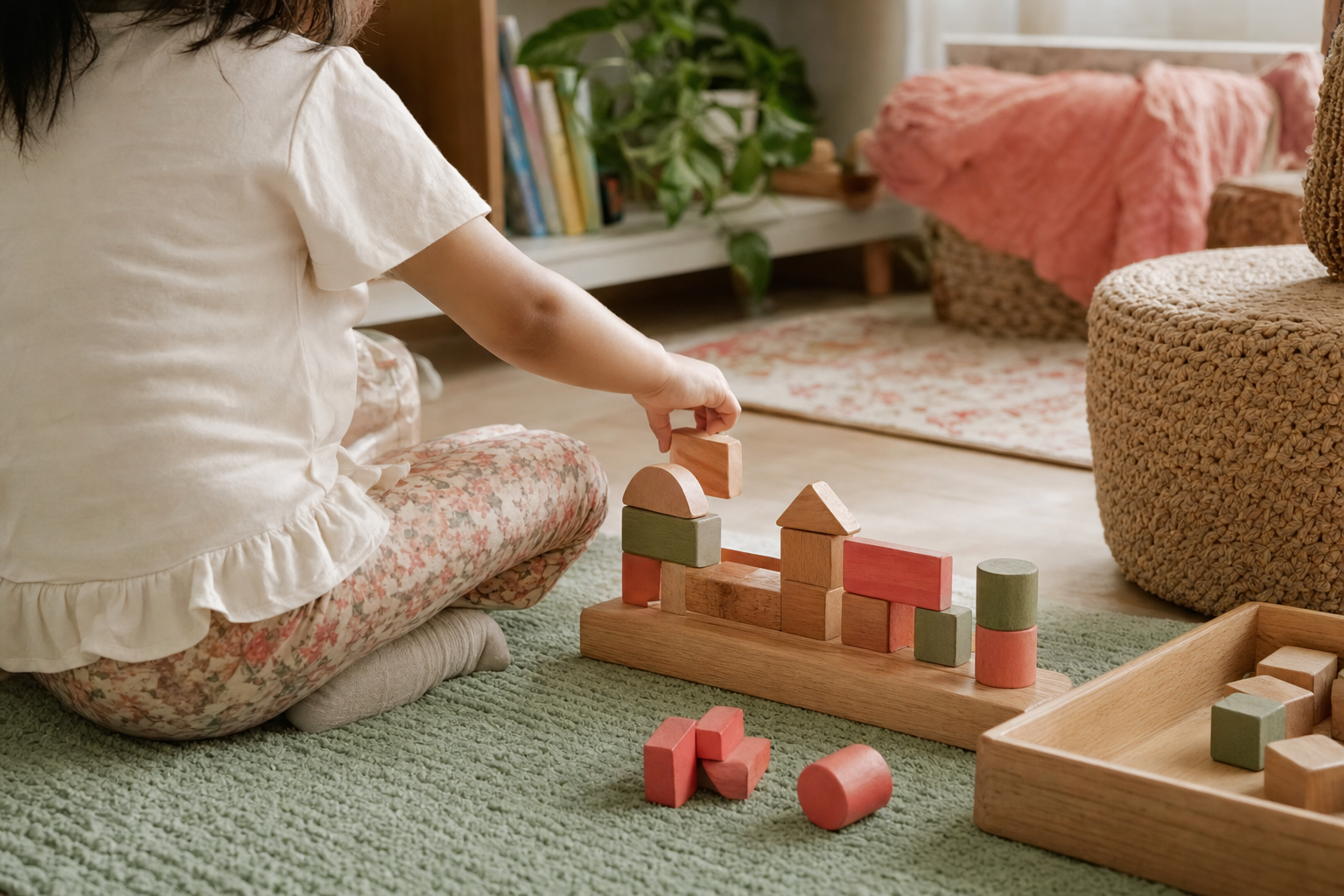
If you’re reading the same board book for the umpteenth time tonight, here’s the reassuring answer to why kids ask to do the same thing over and over: all that repeating is a normal, healthy part of early learning. Zero to Three explains that repetition gives toddlers the practice they need to master new skills. It strengthens the brain connections behind learning, and it builds memory and language too. If words or skills ever seem to slip away, bring that worry to your pediatrician.
Key Takeaways
- Repeat requests are a normal part of growing up: Toddlers commonly ask for a favorite song, story, or game over and over, and that practice helps them master new skills.
- Refrain books build memory and language: Stories with a repeated word or phrase let children anticipate the familiar line, which supports memory and early language.
- Bring developmental concerns to your pediatrician: If you notice lost words, distress when toys are moved out of order, or anything else that worries you, the AAP encourages raising it with your pediatrician.
Is it normal for my toddler to ask for the same thing over and over?
Yes. Wanting the same song, story, or game again and again is normal, and Zero to Three describes that repetition as the practice toddlers need to master new skills. In fact, requesting a favorite song or story over and over is one of the specific ways the organization lists for how young toddlers learn.
So when you hear “again!” at bedtime, at bath time, and once more in the car, your child is doing just what a growing brain is built to do. Zero to Three also calls toddlers “little scientists” who are eager to figure out how everything works. They run small experiments, like throwing a ball to see it bounce and then throwing a doll to see what happens.
Why the “again!” phase feels so intense
Think about what a good scientist does with an interesting result. She runs it again. Your toddler does the same with a song that ends in a tickle, a book where the cow says “moo,” or a game where the blanket comes off and you gasp. Each round checks whether the world still works the way it did last time.
Here’s what we think is going on underneath. Every repeat gives your child’s memory another pass at the same sequence, and Zero to Three notes that a toddler’s growing memory takes on an important role in learning. Toddlers also copy what they see others do, even hours or days later. So the rhyme you sang yesterday may pop up today, rehearsed and requested. That delayed copy is memory at work: your child stored it, held onto it, and pulled it back out when it mattered. You can see how this fits the bigger arc of early growth in our overview of developmental milestones from birth to age five.
You’ll spot repetition when kids play side by side, too. Toddlers playing near each other often copy an action and repeat it, and our guide to the skills parallel play builds walks through why that matters. We’d read all of this as one consistent story: the repeating is the learning, happening right in front of you.
What is happening in my child’s brain on yet another repeat?
On every repeat, your child’s brain is strengthening the circuits it uses most. Harvard’s Center on the Developing Child explains that genes provide the blueprint for brain circuits, and repeated use strengthens whichever circuits get used most often, based on your child’s experiences.
That’s a big idea once it sinks in. The Center on the Developing Child reports that more than 1 million new neural connections are formed every second in the first few years of life, and it calls the early years the most active period for building those connections. New connections keep forming throughout life, so nothing shuts off later. The early years are simply when the building is busiest.
Here’s a picture that may help. Imagine walking across a grassy field. Your first trip barely bends the grass. After lots of trips, there’s a clear path that’s easy to follow. Your child’s favorite book is that walk, taken again and again.
What each repeat is building
Zero to Three says it in everyday terms: rolling a ball repeatedly or reading one book over and over builds brain connections. So your toddler is rehearsing a sequence, a set of words, and a pattern of cause and effect, all at once. Patterns sit underneath so much early thinking, including the first roots of number sense, which we explore in what early math looks like before age 3.
Repetition is also how little kids test predictions. Will the tower fall the same way? Does the dog page always come next? Our post on how your child is a natural scientist shows how that predict, test, and observe loop plays out at home. Every guess that comes true is a small, satisfying win.
We’d read the evidence this way: your boredom is a poor signal to stop. The circuit-strengthening Harvard describes happens through the very repetition that wears on you, so your fatigue is mostly telling you about your own brain. You won’t say yes every single time (more on that below), and still, that umpteenth reading counts.
Why do kids love knowing exactly what comes next?
Kids love knowing what comes next because predictability helps them feel in control. Zero to Three notes that routines are another form of repetition and help a child feel in control. That’s a big deal when nearly everything in your toddler’s day gets decided by grown-ups.
Think about how little your toddler gets to choose. You decide when to leave, what’s for dinner, and when bath time ends. A favorite story is a rare world where your child already knows every turn. Getting the next page right feels good, and that good feeling invites another round.
Routines are repetition too
Zero to Three’s guidance for 15 to 18 months puts routines in the same family as rereading and ball-rolling. A steady bedtime works like a favorite book your child gets to live inside: bath, pajamas, story, song, lights. Our post on creating a calm bedtime routine explains why consistency helps evenings settle.
Put that next to Harvard’s research and we’d say you’ve got a tidy case for routines. Doing things in the same order, night after night, is one more well-walked path. And it hands your child a little control while it’s at it.
Mornings run on that same logic. When getting dressed, eating, and heading out happen in a familiar order, your child can see each step coming. If your toddler has ever corrected you for skipping a page or singing a verse out of order, you’ve watched this need for predictability in action.
Anticipation is part of the fun, too. Zero to Three observes that repeated phrases help toddlers look forward to hearing a familiar line again. That little thrill of “here it comes!” is a pleasure all its own, and we think you can safely read it as joy.
Does reading the same book again help language development?
Yes, rereading helps. Zero to Three recommends stories where one word or phrase keeps coming back, because that repetition helps toddlers look forward to the familiar line and builds their memory and language skills. It also suggests inviting your child to “help” read when you reach the refrain.
Here’s how we’d connect that to everything above. A refrain is a prediction your child gets to make out loud. Memory holds the line, the pattern says it’s coming, and each correct guess walks that path one more time. Hearing the same words in the same rhythm makes them easier to remember and, eventually, to say.
Turning your child into a co-reader
Try pausing just before the familiar line and looking at your child expectantly. Some kids will fill in a sound or a single word at first; others will shout the whole phrase. Either way, you’ve turned listening into joining in, which is the “help me read” move Zero to Three describes. Point to the picture, say the word, wait, and cheer whatever your child offers.
Language grows outside books the same way. Songs with predictable verses, silly rhymes during diaper changes, and running chatter while you play all repeat words in context. Our post on building language skills during playtime has more ideas.
What the evidence doesn’t settle is the ideal mix of old favorites and new titles. Our position is that you don’t need to choose. Keep the beloved book in heavy rotation, offer new ones alongside it, and let your child’s requests tell you which is which on any given night.

Should I ever say no to one more time?
Yes, sometimes, and that’s okay. Zero to Three suggests letting your child try things over and over, or until they tire of it. But bedtime, meals, and getting out the door still set real limits, and a kind close keeps repetition feeling good.
When you’ve got open time, lean toward yes. A slow weekend morning is a perfect moment to let the block tower fall again and again, or to sing one song until your child wanders off on their own. That “until he tires of it” advice from Zero to Three is worth honoring whenever your schedule allows. We’d trust your child to judge when a skill feels finished.
Kind ways to close a round
Family life still has a clock, though. When you need to stop, these tend to land gently:
- Give a heads-up. Let your child know the end is coming soon, then count down the last rounds together.
- Name the last one. “This is the last time tonight” helps your child get ready.
- Promise a return. “We’ll read it first thing tomorrow” keeps the favorite safe.
- Carry it into the transition. Hum the song on your way to the bath, or let your child hold the book at the table.
Timing matters. A hungry or worn-out child may protest the end of a round much more than usual, and late afternoons can be a tough stretch, as we explain in our post on the late-afternoon crash. If a big reaction follows, our guide to telling a tantrum from a sensory meltdown can help you decide how to respond.
How can I make endless rounds less tedious for me?
Change one small thing. Try a silly voice, or hand your child the lead. Harvard’s Center on the Developing Child names responsive serve-and-return interactions as a key influence on brain development, so how you show up during the repeat matters too.
Serve and return works like a game of catch. Your child “serves” with a word, a point, or a look, and you “return” it with attention and a response. The Center on the Developing Child explains that when caregivers are attentive and responsive to a child’s signals, they create an environment rich in these experiences. So you’ve got full permission to play with the repeat.
We’d connect Harvard’s brain-architecture and serve-and-return concepts like this. Repetition gives your child a well-worn path. Your responses turn each walk down it into a two-way conversation.
Ask, then wait
Questions freshen up a story you could recite in your sleep. “What do you think the bear is feeling?” or “Where would you hide?” turns a page you’ve read countless times into real back-and-forth, which is just the serve and return Harvard describes. Our list of open-ended questions to ask your toddler is handy here.
Voices help, too. Whisper the whole book. Give the duck a deep, grumpy voice. Sing the words. Or hand over the book and let your child “read” to you, describing the pictures in their own words. Each of these keeps the familiar structure your child loves and gives you something new to do.
We’ll be honest: tedium is real, and admitting it doesn’t make you a less devoted parent. Our view is that your boredom is useful information about you, so the fix is to change your part of the game and let your child’s part keep going.
How do I nudge my child toward something new?
Wait until your child has mastered the familiar version, then add a small twist. In its guide to thinking skills from 12 to 24 months, Zero to Three gives a simple example: once your child has mastered rolling a ball, bounce it to them, so the new challenge rests on a skill they already own.
Here’s why we think that timing matters so much. If repeated use strengthens the circuits your child relies on most, as Harvard’s Center on the Developing Child explains, then all those rounds of ball-rolling are what make the bounce possible. The twist lands on a path your child has already worn smooth. Bring it in too early, and we’d guess you’re asking your child to walk a new path before the first one is fully built.
You can usually read the moment. While your child is still working out the original game, they’ll tend to want it unchanged. We’d look for the point where it seems easy and relaxed. And if your twist gets a frown, that’s your cue to go back to the familiar version for a while.
Novelty layered on the familiar
Twists work best when most of the activity stays put. Here are some easy ones:
- Keep the favorite song but add a verse about your child’s stuffed animal.
- Read the beloved book but ask your child to find something new on each page.
- Build the usual tower, then try it with a new set of objects.
- Play your regular hiding game in a different room.
Mixing familiar and new is close to how inquiry works at any age. Kids ask a question, try something, and notice what changes, which is the heart of inquiry-based learning. A small twist invites your child to wonder “what happens if?” and keeps the comfort of the original.
Curiosity grows when kids feel safe enough to explore. We’d argue the familiar game is the secure base that makes a new one possible, so you can keep a favorite around for as long as your child wants it. For more on how that wonder develops, see our post on how wonder leads to lifelong learning.
When does repetition become a reason to call the pediatrician?
Call your pediatrician if repetition comes with lost words or skills, distress when objects are moved out of order, or anything else that worries you. The American Academy of Pediatrics stresses that you know your child best and that your concerns are important.
Most “again!” requests reflect ordinary learning, as Zero to Three describes. Still, the CDC lists examples of restricted or repetitive behaviors related to autism spectrum disorder, including lining up toys or other objects and getting upset when the order is changed, and repeating words or phrases over and over (called echolalia). The CDC also describes social signs, such as a child who does not point to show you something interesting by 18 months of age. And it notes that children with autism may not have all, or any, of the behaviors listed.
Regression and routine screening
Lost skills deserve particular attention. The American Academy of Pediatrics explains that about 25% of children later diagnosed with autism may develop some language that they suddenly or gradually stop using, typically between the ages of 15 and 24 months. These children may also become more socially withdrawn. Pediatricians call this a regression in skills.
Routine checkups help catch concerns early. The AAP recommends that all children be screened for autism at their 18- and 24-month well-child checkups, along with routine developmental surveillance. Bring what you’ve noticed to those visits, or call sooner if something worries you. Our guide to preschool readiness signs can help you organize your observations.
Here’s how we’d read these sources together. A child who asks for the same book while looking at you, laughing at the funny part, and pointing to share the moment is showing the social connection the CDC describes. If repetition starts to crowd that connection out, or your child seems to lose interest in sharing moments with you, a conversation with your pediatrician is the right next step.
What does repetition-rich care look like outside the home?
Look for consistent caregivers, predictable routines, adults who respond when children reach out, and teachers who let a child repeat before gently extending play. Harvard’s Center on the Developing Child ties healthy brain architecture to stable, interactive relationships with caring adults.
What to notice in any care setting
Spend a few minutes simply watching. Does an adult answer a child who isn’t asking loudly? Is a child who wants to build that same tower again allowed to finish? Look for the serve-and-return rhythm the Center on the Developing Child describes: a child offers something, and an adult responds. A play-based day leaves room for both repetition and new challenges, as our play-based preschool guide explains.
We’d draw the threads together this way. Repetition builds the path, and serve and return keeps a familiar game social. Both depend on an adult who knows your child well enough to notice the serve. That’s why familiar faces, day after day, carry so much weight at this age, and why your own patience with “again!” is some of the most useful attention you can give.
| Fact | Detail |
|---|---|
| Founded | 2010 |
| Locations | 8 New Jersey campuses across East Hanover, Harrison, Hoboken, Lyndhurst, Paramus, and Parsippany-Troy Hills |
| Curriculum | EsteamED Curriculum® (proprietary) |
| Age range served | 6 weeks – 5 years |
| Programs | Infants, Toddlers, Preschool |
| Hours | Monday-Friday, open 7:00 AM-7:30 AM, close 6:00 PM-7:00 PM (varies by campus) |
| Languages introduced | American Sign Language and Spanish at every campus; Mandarin immersion at the Hoboken campuses |
| Tagline | Exceptional Early Education™ |
Frequently Asked Questions
Is it normal for my toddler to ask for the same thing over and over? Yes. Wanting the same song, story, or game again and again is normal, and Zero to Three describes that repetition as the practice toddlers need to master new skills. In fact, requesting a favorite song or story over and over is one of the specific ways the organization lists for how young toddlers learn.
What is happening in my child's brain on yet another repeat? On every repeat, your child's brain is strengthening the circuits it uses most. Harvard's Center on the Developing Child explains that genes provide the blueprint for brain circuits, and repeated use strengthens whichever circuits get used most often, based on your child's experiences.
Why do kids love knowing exactly what comes next? Kids love knowing what comes next because predictability helps them feel in control. Zero to Three notes that routines are another form of repetition and help a child feel in control. That's a big deal when nearly everything in your toddler's day gets decided by grown-ups.
Does reading the same book again help language development? Yes, rereading helps. Zero to Three recommends stories where one word or phrase keeps coming back, because that repetition helps toddlers look forward to the familiar line and builds their memory and language skills. It also suggests inviting your child to "help" read when you reach the refrain.
Should I ever say no to one more time? Yes, sometimes, and that's okay. Zero to Three suggests letting your child try things over and over, or until they tire of it. But bedtime, meals, and getting out the door still set real limits, and a kind close keeps repetition feeling good.


