
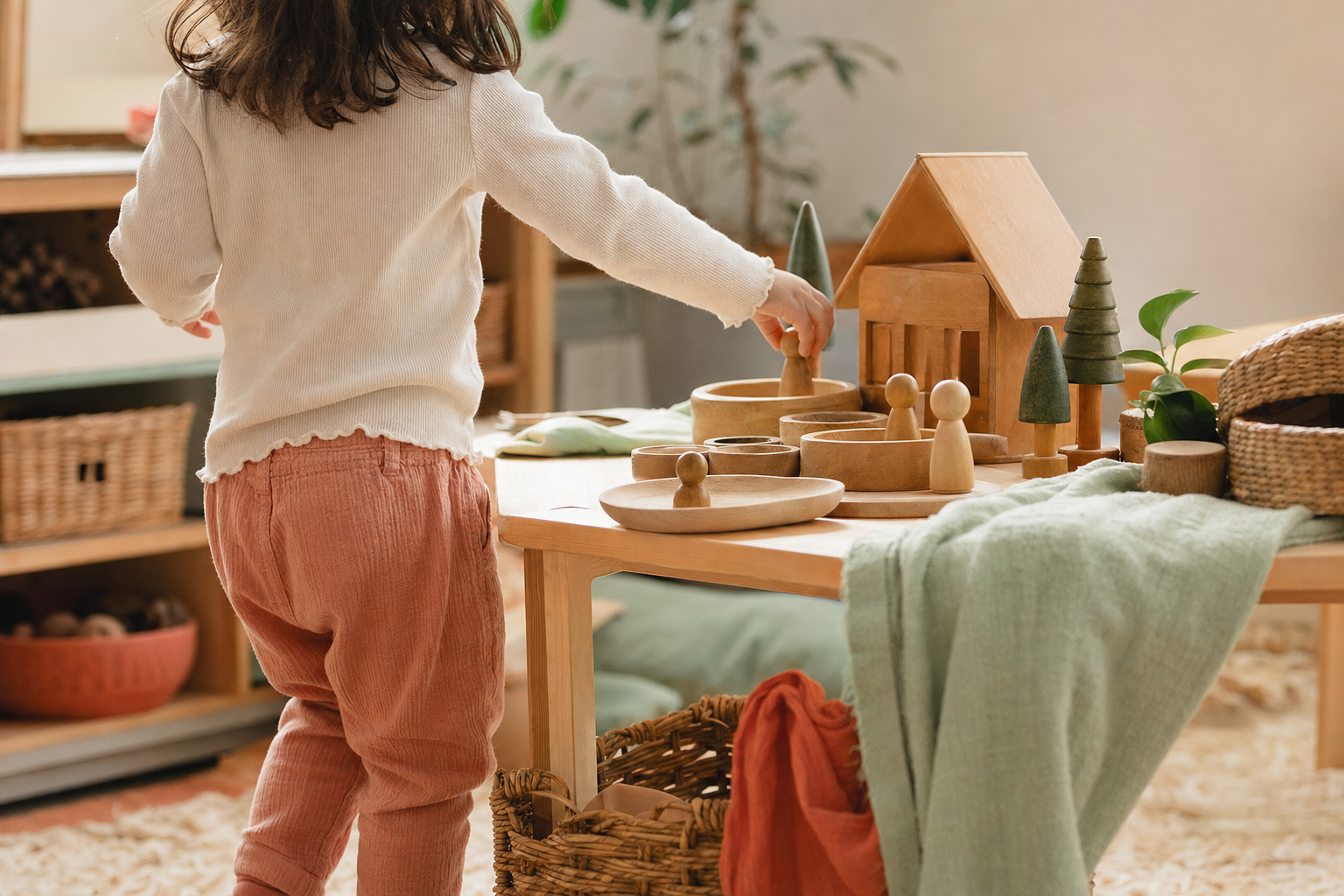
Pretend play matters because it gives your toddler or preschooler meaningful practice with symbols, feelings, self-made rules, and language. In its clinical report on the power of play, the American Academy of Pediatrics ties play with parents and peers to the skills that build executive function. Your child will lean on those skills later for reading, math, and friendships. So here’s why pretend play matters for toddlers and preschoolers, one question at a time.
Key Takeaways
- Pretending is symbol practice: A child who uses a spoon as a hairbrush is learning that one thing can stand for another, the same idea that later makes words, letters, and numbers meaningful.
- Feelings get a rehearsal: Soothing a crying doll or playing an angry monster gives children safe practice with emotions, and children who do more of this play show stronger emotion knowledge and regulation.
- Adults set the stage and follow: Parents support pretend play best by offering time, space, and simple props, then letting the child lead the scene.
What counts as pretend play for a toddler?
Pretend play is any moment your toddler treats one thing as if it were something else, acts out a familiar routine, or takes on a role. A spoon becomes a hairbrush. A doll gets tucked in for a nap. A toy phone gets a very serious call. Each of these counts, however brief the moment may be.
Three shapes of early pretending
Object substitution usually comes first. According to the AAP’s HealthyChildren site, when a child uses one object to stand for another, like a spoon for a hairbrush or a tablecloth for a cape, that child is thinking symbolically. You’ll spot it at breakfast, in the bath, and anywhere your toddler finds something to repurpose. Watch for that little pause before the switch, when your child seems to decide what the object is going to be.
Routines come next. Many toddlers enjoy replaying the familiar routines around them, so you may notice yours stirring an empty pot, wiping a table, or pushing a stroller full of stuffed animals. One of the clearest examples sits in the CDC’s milestone checklist for 30 months, which says most children by then use things to pretend, like feeding a block to a doll as if it were food. If you want the wider picture, our guide to development milestones from birth to five shows where that skill sits among the others.
Roles are another shape this play can take. Your toddler might put on your shoes and announce a trip to work, or crawl around barking like a dog. Early role play is usually brief and loose. Many toddlers act out scenes near other kids without joining in, a stage we explore in the post on what parallel play builds.
We’d count all of it. Once you start watching for these moments, you’ll find far more pretending than any toy catalog suggests, and every short, messy bit of it is real.
Why does pretend play matter for brain development?
Pretend play matters for brain development because play with parents and peers builds the social-emotional, cognitive, language, and self-regulation skills behind executive function, according to the American Academy of Pediatrics. Pediatricians treat play as serious developmental work, and the research they cite backs them up.
What the AAP report says
The AAP’s clinical report, The Power of Play, describes developmentally appropriate play with parents and peers as a singular opportunity to promote the social-emotional, cognitive, language, and self-regulation skills that build executive function and a prosocial brain. That’s strong language for a medical journal. Pediatric reports tend to hedge, so when one doesn’t, it deserves your attention.
Two more points from the report stand out. Play, the authors write, enhances brain structure and function and promotes executive function, which they frame as the process of learning. Executive function covers the skills that let you chase a goal and tune out distractions. If you’ve ever watched a preschooler try to wait for a cookie, you know those skills are still under construction.
Pretend play can give young minds a genuine workout. When your child plays bus driver, they have to remember the route, wait for passengers to climb aboard, and resist steering off toward the park. Holding a goal, waiting, and switching plans are executive-function tasks dressed up as fun. Outdoor play works some of the same muscles, as we explain in the post on outdoor time and executive function.
In our reading, the research is clear that play belongs at the center of a young child’s day. It describes skills that build slowly across the early years, and it doesn’t link any single afternoon of dress-up to a particular test score, so we’d hold it with some humility and still take it seriously.
So when your preschooler insists on finishing the pretend birthday party before bath time, let the candles get blown out. That party is doing real work.
How does make-believe prepare children for reading and math?
Make-believe prepares children for reading and math by teaching symbolic thinking, the idea that one thing can stand for another. Letters stand for sounds and numbers stand for quantities. So when your toddler treats a block as a phone, they’re practicing the same mental move reading and math will ask for later.
Symbols first, letters later
Zero to Three puts it plainly in its piece on why pretending matters: just like the block can be a symbol for a phone, letters and numbers are symbols for sounds and quantities. Reading asks your child to accept that marks on a page carry meaning. Math asks the same of numerals. Both rest on a habit pretend play starts building early.
A second Zero to Three resource, on thinking skills from 24 to 36 months, widens the list. Understanding symbols, it notes, is important for math, logic, writing, and science, and one of its examples is a shoebox becoming a home for stuffed animals. Each time your child decides a box is a house, they’re rehearsing the logic a written word will ask of them later.
Plenty of early math shows up in play, too. Before toddlers count with confidence, they sort, compare, and notice more and less, often right in the middle of a game. A pretend picnic hands them plates to share out and snacks to divide, and our guide to what early math looks like before age three shows how much of that thinking happens while kids play.
For reading, the bridge runs through stories. When your child acts out a trip to the doctor, they’re building a sequence with a beginning, a problem, and an ending, which is the same shape most picture books follow. Pair pretend play with steady book time and both habits grow together. If routines shift in the fall, a simple September reading ritual can help.
We find the symbol argument the most convincing reason to protect make-believe before school starts. It explains the link between pretending and letters without overpromising what pretending will do.
Can pretend play help my child handle big feelings?
Yes. Pretend play gives your child a safe place to practice feelings, and the Child Mind Institute reports that kids who do more of this play show stronger emotion knowledge and regulation. Acting out a feeling lets them try it on from a comfortable distance.
Rehearsal at a safe distance
In its article on the power of pretend play, the Child Mind Institute gives two everyday examples: children might practice soothing a crying baby doll or act out an angry monster. Both scenes let your child handle a strong feeling while staying in charge of the story. If the monster gets too scary, your child can just stop being the monster.
Comforting a doll is empathy practice. Your child has to notice the doll’s “feelings,” guess what might help, and try it, which is a small version of what a friend does on the playground. Playing the monster works the other way. It gives anger and fear a shape your child can roar out and then put away.
Here’s our position: emotional pretend play is worth protecting even when it looks dark or repetitive, because the research ties more of it to stronger regulation. We’d read the repetition as part of the work. Each replay lets your child run the same big feeling again, and each time they get to decide when the monster roars and when it stops. That growing sense of being in charge of a scary feeling sits close to what regulation means, so a monster who roars over and over is still rehearsal.
Pretend scenes also hand you words. If your preschooler announces that teddy is sad because nobody shared, you can wonder aloud what sad feels like and what teddy might need. Naming feelings in the low-stakes world of play is one of the easiest ways to start building your toddler’s emotional vocabulary, and it fits the wider picture of social-emotional learning in early childhood.
Save play for calmer moments, though. For what helps your child calm down during a meltdown, your pediatrician is the best guide, and knowing whether you’re facing a tantrum or a sensory overload shapes that conversation, as our guide to tantrums versus sensory meltdowns lays out. Once everyone has settled, a doll replaying the scene can help your child make sense of what happened.
Does pretend play build language and conversation skills?
Yes. Pretend play builds language because using one object to stand for another is the same symbolic thinking words depend on. A word stands for a thought or an idea, and pretending lets your child practice that with their hands as well as their voice.
Talk that follows the scene
The AAP’s HealthyChildren article on how children exercise their imagination makes that link directly, calling symbolic thinking key to learning and using language, since words also stand for thoughts and ideas. Pretend scenes give kids a reason to talk, too. Characters need names. The restaurant needs an order. The sick puppy needs someone to explain what hurts.
We’d lean toward following your child’s script over correcting it, since what you’re after is more talk and more back-and-forth. So all three of these moves keep your child in charge. Narrate what you see (“Your bear is stirring that soup so carefully”). Ask open-ended questions like “What happens next?” or “Who’s coming to dinner?” And drop in a new word where it fits, such as ladle, customer, or thermometer. You’ll find more ideas in our post on building language skills during playtime.
Questions work best when there’s no right answer, and a ready list of open-ended questions to ask your toddler gives you prompts to keep in your back pocket. Leave space after you ask. Your child may need a long pause to find the words, and if you rush to fill the silence, the exchange can end right there.

Is it okay if my toddler pretends alone or beside other children?
Yes. Pretending alone or beside other kids is a normal part of toddlerhood, because toddlers are only beginning to develop simple imaginary play. Shared make-believe, with agreed roles and rules, tends to grow later in the preschool years.
What solo pretending is doing
Harvard’s Center on the Developing Child, in its executive function activities for 18 to 36 months, notes that toddlers are beginning to develop the capacity for simple imaginary play. “Beginning” is the key word. When your toddler feeds a doll alone, they’re building the basic skill. A group game asks for extras, like sharing a storyline, and those take more time.
Here’s why we’d treat solo pretending as the foundation. To pretend a block is a phone, your toddler has to hold two ideas at once: what the block is, and what it’s standing in for. That’s the symbol skill Zero to Three ties to letters and numbers. A shared game stacks more on top. Now your child has to hold their own idea, a friend’s idea, and the rules you’ve both agreed on, which is the rule-making Harvard describes for 3- to 5-year-olds. So a toddler pretending alone is right on schedule, practicing the first layer that group play will build on.
Playing side by side counts, too. Two toddlers can each run a pretend kitchen right next to each other, glance over, copy a move, and never say a word, and both still get something out of it. Our post on parallel play and the skills it builds covers that stage in more depth.
Solo play has its own payoff. If your child can settle into a pretend scene without you running it, they’re practicing focus and self-direction, both handy once preschool begins. That same Harvard guide suggests offering a variety of familiar household objects, toys, and clothing items to encourage imaginary play, and our guide to fostering independent play before preschool offers gentle ways to start.
Still unsure whether your toddler is on track? Bring the CDC’s milestone checklist to your next well visit and talk it through with your pediatrician. It’s an easy, low-pressure way to get a real answer.
How does pretend play change from toddler to preschooler?
Pretend play shifts from short, single actions with familiar objects in toddlerhood to intentional imaginary play in the preschool years, where kids set rules for roles and stick to them. Your child will make that change gradually and unevenly, at their own pace.
From single acts to shared stories
Toddler pretending tends to happen one move at a time. A block gets fed to a doll, one of the behaviors the CDC lists among what most children do by 30 months, and then the doll gets dropped for the next interesting thing. Familiar objects carry most of the weight, and there’s rarely a plot.
Preschoolers start building stories. Harvard’s activity guide for 3- to 5-year-olds describes what happens in intentional imaginary play: children develop rules to guide their actions in playing roles, hold complex ideas in mind, and shape their actions to follow those rules. Holding back impulses that don’t fit the role is part of the job.
Think about what a preschool “doctor” has to manage. Doctors listen with a stethoscope, wait while the patient explains, and leave the patient’s toy alone, so staying in character is self-control practice. Kids also police the rules for each other (“You can’t fly, you’re the dad!”), and that’s executive function at work in a group.
We read this move into rule-based pretending as one of the clearest signs that self-control is coming online, and we’d give it more weight than early letter drills. It lines up with other markers you may already be watching. Our guide to play-based learning for 3-year-olds shows what it looks like day to day, and the posts on preschool readiness signs and emotional readiness for preschool explain why waiting, taking turns, and sticking to a plan matter so much in a classroom.
What should I look for in a preschool’s dramatic play area?
Look for a dramatic play area stocked with dress-up clothes, open-ended props, and familiar household items, plus adults who give kids time to play without directing every scene. The space matters, and so do the people around it.
A short checklist for your visit
You can use this checklist at any early-childhood program you visit, and you won’t need a clipboard. Watch for these:
- Dress-up clothes, uniforms, capes, and masks that let kids try on many kinds of roles.
- Props for real-world scenes, like a play kitchen, restaurant menus and order pads, a doctor kit, or a pretend shop.
- Familiar household objects, toys, and clothing, which Harvard’s Center on the Developing Child recommends offering to encourage toddlers’ imaginary play.
- Open-ended materials such as blocks, scarves, and boxes that can become anything.
- Enough room and time for a scene to unfold before it gets cut short.
Props are only part of the picture. The AAP’s guidance on the power of play encourages giving kids time and space to act out imaginary scenes, roles, and activities, and letting play stay unstructured. So notice whether kids get long, unhurried stretches to build a story, or whether every activity runs on a tight clock.
Then watch the adults, because we’d weigh them more heavily than the props. A well-stocked corner goes unused if nobody protects the time for it. Does a teacher join a scene with a question and then step back? And when a quiet child plays alone, do they get a warm word, too? We’d also ask how small the groups are and how long teachers have been with the same kids. The sources here don’t measure caregiver consistency directly. Given how much the AAP ties play to relationships with parents and peers, though, we think it’s a fair question. Our guide to what responsive caregiving looks like on a tour has more to watch for, and the overview of preschool programs for 4-year-olds covers what older preschoolers need.
How can I encourage pretend play at home without taking over?
Encourage pretend play at home by offering time, space, and simple props, then letting your child lead while you play a supporting role. Join when you’re invited, follow the story your child is telling, and resist the urge to steer it toward a lesson.
Easy setups that invite make-believe
Start with what you already have. The CDC’s tips for this age suggest letting your child play with large boxes and pretend one is a car, bus, train, or house, then color it, paint it, and add stickers. That same page encourages letting your child pretend to cook using safe things from your kitchen, such as a pot and a wooden spoon.
Props don’t need to be fancy. The AAP’s advice on play notes you can provide dress-up clothes and props while letting play stay unstructured. An old scarf, a hat, a toy phone, and a laundry-basket boat will carry most toddlers a long way, and simple stuff leaves more room for imagination than toys that only do one thing. Time matters as much as props, so we’d protect the boring, unscheduled stretches in your week. Make-believe needs empty time to show up.
On quiet afternoons, a few screen-time alternatives can open the door, and we’d pick whichever ones leave your child the most room to invent the story. If you want the longer view, our guide on nurturing imagination from infancy to preschool follows creativity across the early years.
Taking a supporting role is the hard part. Let your child cast you as the customer, the patient, or the baby who needs a bath. Ask questions and let your child hand out the directions. Harvard’s Center on the Developing Child describes preschoolers inventing their own rules during imaginary play, and kids get the most room to do that when you follow their lead. So if the story wanders somewhere odd, let it wander.
| Fact | Detail |
|---|---|
| Founded | 2010 |
| Locations | 8 New Jersey campuses across East Hanover, Harrison, Hoboken, Lyndhurst, Paramus, and Parsippany-Troy Hills |
| Curriculum | EsteamED Curriculum® (proprietary) |
| Age range served | 6 weeks – 5 years |
| Programs | Infants, Toddlers, Preschool |
| Hours | Monday-Friday, open 7:00 AM-7:30 AM, close 6:00 PM-7:00 PM (varies by campus) |
| Languages introduced | American Sign Language and Spanish at every campus; Mandarin immersion at the Hoboken campuses |
| Tagline | Exceptional Early Education™ |
Frequently Asked Questions
What counts as pretend play for a toddler? Pretend play is any moment your toddler treats one thing as if it were something else, acts out a familiar routine, or takes on a role. A spoon becomes a hairbrush. A doll gets tucked in for a nap. A toy phone gets a very serious call.
Why does pretend play matter for brain development? Pretend play matters for brain development because play with parents and peers builds the social-emotional, cognitive, language, and self-regulation skills behind executive function, according to the American Academy of Pediatrics. Pediatricians treat play as serious developmental work, and the research they cite backs them up.
How does make-believe prepare children for reading and math? Make-believe prepares children for reading and math by teaching symbolic thinking, the idea that one thing can stand for another. Letters stand for sounds and numbers stand for quantities. So when your toddler treats a block as a phone, they're practicing the same mental move reading and math will ask for later.
Can pretend play help my child handle big feelings? Yes. Pretend play gives your child a safe place to practice feelings, and the Child Mind Institute reports that kids who do more of this play show stronger emotion knowledge and regulation. Acting out a feeling lets them try it on from a comfortable distance.
Does pretend play build language and conversation skills? Yes. Pretend play builds language because using one object to stand for another is the same symbolic thinking words depend on. A word stands for a thought or an idea, and pretending lets your child practice that with their hands as well as their voice.


