

Hand sanitizer and gummy vitamins get the shelf space, while sleep, a habit with real research behind it, barely gets a mention. For toddler sleep and immunity, the load-bearing numbers are hours: 11 to 14 hours per 24 including naps for one- and two-year-olds, according to KidsHealth, plus a bedtime that lands in the same window nightly and a wind-down that runs the same way Saturday as it does Tuesday. Cresthill Academy is an early-childhood education and child-care provider, and here’s our position: the boring plan carries more weight.
Key Takeaways
- Sleep is a documented immune input: Interactions between sleep and the immune system have been well documented, which places protected sleep hours alongside handwashing and vaccination in any cold-season plan.
- Consistency holds the schedule together: Consistent routines give young children comfort and a sense of safety, and keeping weekend shifts within one to two hours preserves the week’s sleep totals.
- Handwashing and vaccination stay on the list: Preventive habits include plenty of sleep, physical activity, fluids, and nutritious food, with annual vaccination named the single best step against the flu.
Two cold-season playbooks parents actually run
Walk the cold-and-flu aisle in early fall and you can watch the first playbook get assembled in real time. Elderberry syrup. A chewable multivitamin, a fresh pump of sanitizer by the front door, a humidifier for the bedroom, maybe a probiotic someone recommended in a group chat. None of that is foolish, and the impulse behind it is a good one, though whether any particular supplement belongs in your house is a question for your pediatrician. What it has in common is that it’s reactive, purchasable, and visible.
Playbook two is quieter and much harder to photograph. Bedtime gets treated like a fixed appointment rather than a suggestion. Screens go dark before the bath. Weekend mornings drift a little but not much, and the family gives up some evening flexibility in exchange for a child who logs the hours their body is asking for. Nobody posts about it, because there’s nothing to unbox.
Why the quiet playbook has the stronger paper trail
Here’s the honest asymmetry between the two. Harvard Medical School’s sleep education program puts it plainly: interactions between sleep and the immune system have been well documented. And when the CDC lists the everyday actions that help prevent flu, getting plenty of sleep sits right alongside physical activity, fluids, and nutritious food, with annual vaccination named the single best step. Sleep is on the official list. Elderberry is not.
That doesn’t make the shopping-cart items useless. A humidifier may well have a place among them, and we cover the safety side of that in our guide to steam versus humidifiers, just as we cover the practical end of a stuffy toddler in managing snotty noses and the food end in winter recipes kids will actually eat. The point is ordering. If a supplement still appeals to you, that’s a conversation worth having with your pediatrician, but the bedtime routine is the piece to put in place first.
Which does more for immunity: the supplement shelf or a protected bedtime?
Food and sleep are both on the prevention list, and one of them is free.
The measured effect of short sleep is the part most parents have never seen. In sleep-restriction research summarized by the CDC, cutting sleep to four hours for a single night reduced natural killer (NK) cell activity to an average of 72% compared with a full night. We’d hold a single laboratory figure like that carefully rather than read it as a measurement of what happens inside any one child on a short night, but the direction it points is hard to ignore. Sleep restriction moves immune measurements in a direction nobody wants.
Where nutrition genuinely earns its place
Alongside that lab finding sits the outcome parents care about. The Sleep Foundation notes that insufficient sleep makes it more likely to catch the common cold or the flu, with research also suggesting sleep helps strengthen immune memory. So the mechanism and the sniffles line up reasonably well. Reading that evidence, we’d put protected hours in the same tier as handwashing rather than in the tier of hopeful extras.
Food still matters, of course. A toddler eating varied meals, drinking enough, and moving their body is covered on that front, which is mostly a question of what’s in the kitchen and what’s in the snack rotation. If snacks have crept into every gap in the day, our post on resetting toddler snack habits is a better starting place than a vitamin aisle, and winter recipes for kids covers the rest.
Spend your effort where the evidence is thickest: sleep and real food come first, with optional bottles well behind them.
Consistent bedtime versus a bedtime that moves
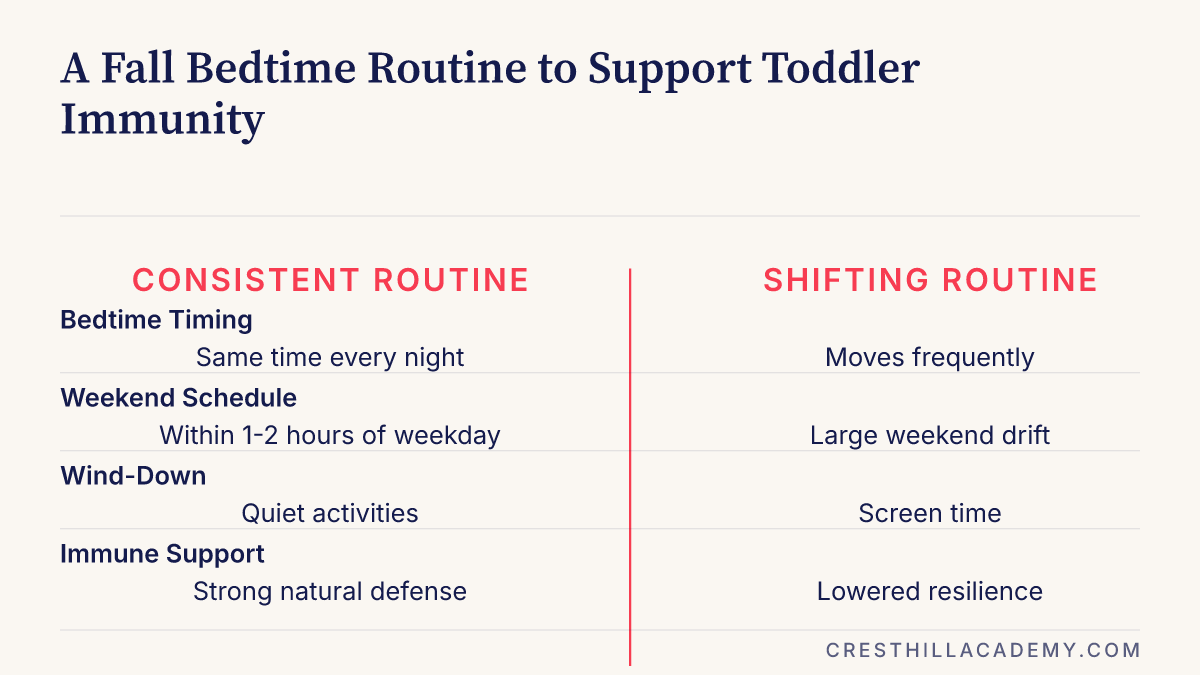
Two families can both hit twelve hours and have completely different evenings. In one house, lights-out drifts from night to night depending on dinner, traffic, and whether an older sibling had a game. In the other, the sequence barely varies. Same order, same room, same songs. Sameness feels dull to an adult and reads as safety to a two-year-old.
Zero to Three makes that case directly: consistent routines provide comfort and a sense of safety to young children and make the hardest transitions, bedtime especially, easier to get through. A predictable sequence tells your child what’s coming next without anyone having to argue about it. Prediction is what lowers the resistance.
The follow-through is the active ingredient
There’s a second finding worth sitting with. Children whose parents establish and follow through on clear bedtime routines tend to learn to be good sleepers, per Zero to Three, which also suggests a plain environmental audit: is the room dark, is it quiet, is the TV off, is the nightlight dim? Four questions, answerable tonight, no purchase required.
We read “follow through” as the working part of that sentence. A routine written down and then abandoned whenever the evening gets busy teaches very little, while a modest routine kept consistently teaches a great deal. If bedtime has drifted past recognition, our walkthrough on rebuilding a sleep routine gives you a sequence to work from, and if the resistance is really about being apart from you, separation anxiety as a part of growing up is the more useful read.
A bedtime that shifts unpredictably from one night to the next asks your toddler to renegotiate sleep from scratch, every single evening.
One nap or two: how the schedule shapes the 24-hour total
Nap math confuses parents because the target isn’t a bedtime, it’s a 24-hour figure. The American Academy of Pediatrics, which supports the AASM sleep guidelines and encourages parents to build good sleep habits from the start, frames the totals across a full 24 hours. Naps count toward the total. So a schedule change during the day always shows up somewhere at night.
Now the size of the daytime contribution. The Sleep Foundation reports that toddler napping frequently accounts for around 1 to 2 hours of daily sleep, and that many older toddlers take just one afternoon nap. Set that against the 11-to-14-hour band for one- and two-year-olds, and the arithmetic gets clear fast: the night is doing most of the work, whichever nap structure you’re running.
What changes when two naps become one
Dropping a morning nap usually removes daytime sleep from the ledger, and the total has to come from somewhere. Bedtime moving a bit earlier is the ordinary answer. Group-care days can shift things too, since the rhythm of a full day away is different from a day at home; our comparison of what changes between infant and toddler care and our look at a typical infant daycare daily schedule both show how the day gets shaped.
Preschoolers run on a slightly different band, 10 to 13 hours per KidsHealth, and many of them stop napping altogether during that stretch. That transition is bumpy for most families and it comes when your child is ready rather than on a date you pick. Watch the 24-hour total, and let the nap be a variable rather than the goal.
Is an earlier bedtime better than a longer nap?
When the 24-hour total comes up short, we’d protect the night first, since naps typically supply only an hour or two and the night has to carry the remainder. An earlier bedtime is also the change most likely to hold in a busy household.
There’s a practical reason too. Stretching an afternoon nap can quietly steal from the evening, because a child who sleeps late in the day may simply not be tired when the bedtime routine starts. So you win an hour in the afternoon and lose it after dinner, usually with more negotiating attached. The total barely moves and the evening gets worse.
Moving bedtime without a fight
Shifting bedtime works better in small steps than in one dramatic jump. CHOP’s healthy-sleep guidance recommends a consistent bedtime routine with a wind-down period of quiet, calming activities like a bath or reading, and no caffeine in the afternoon or evening, which is worth a look at the ingredient list on chocolate milk and iced tea. Keep the sequence identical and let the clock be the only thing that changes.
If the whole schedule needs rebuilding rather than nudging, work from a plan instead of improvising nightly; our sleep-routine rebuild guide lays out an order of operations. Give any change time to settle before you judge it, because the earliest nights of a new bedtime tell you far less than the pattern that emerges once the routine has grown familiar.
When you have to choose between a longer nap and an earlier lights-out, the earlier lights-out is the change with more upside and less collateral damage.
Quiet wind-down versus screen wind-down
Picture the same 45 minutes spent two ways. Version one: bath, pajamas, two books on the floor, a song, lights out. Version two: a tablet propped against the couch cushion, one more episode, then a scramble into pajamas with the screen still glowing across the room. Both take three quarters of an hour. Only one of them is winding anything down.
The guidance here is specific and easy to follow. KidsHealth advises turning off all screens at least one hour before bedtime. Zero to Three’s bedtime audit points the same direction with its questions about a dark, quiet room with the TV off and the nightlight dim. Two independent sources, one shared instruction: the last stretch of the evening should be dull on purpose.
What to put in the hour instead
An empty hour is the reason screen rules collapse, so decide in advance what fills it. Books, a bath, sorting laundry by color, a slow puzzle, quiet talk about the day, a back rub. CHOP’s advice to build the wind-down around quiet, calming activities gives you wide latitude, and boring is a feature at that hour. Our roundup of screen-time alternatives has more options than any one family needs.
One more lever sits earlier in the day. Physical activity is on the CDC’s prevention list, and a child who has genuinely moved outdoors tends to arrive at bedtime with something to spend, which is part of why we like the case laid out in outdoor time and executive function. Front-load the movement, then let the last hour go quiet.
Weekday schedule versus weekend drift
Monday through Friday, the schedule mostly runs itself, because school or care sets the wake time and the day has edges. Then Saturday arrives with a late dinner out and Sunday brings a nap in the car at an odd hour, and by Monday morning your toddler is running on a rhythm noticeably out of step with the one the week requires. The weekend is where most carefully built routines quietly come apart.
Cap the drift rather than banning it. CHOP’s sleep guidance suggests keeping weekend shifts to one to two hours rather than letting the clock float freely. That’s a workable rule for a real family: a somewhat later bedtime on the weekend is fine, while a large swing in timing paired with an unusually late nap is the kind of thing that costs you Monday. Aim for the same order of events even when the timing slides.
Protecting weekend hours is unglamorous work, and it’s also the difference between a routine that survives September and one you rebuild every Monday, which our routine rebuild guide exists to help with.
Sleep, handwashing, and vaccination: what each one contributes
These three layers do genuinely different jobs, and it helps to see them separately. Handwashing removes germs from hands before they reach a face. Vaccination prepares the immune system for a specific virus ahead of exposure. Sleep supports the system that has to respond once exposure happens anyway, which in a room full of toddlers it eventually will.
Start with hands, because it’s the layer a two-year-old can participate in. The CDC advises parents to teach children the correct way to wash their hands, noting that washing with soap removes germs and makes them less likely to infect the respiratory system. Technique is the whole game there. Soap, friction, and enough time beat a quick rinse by a wide margin.
Vaccination and sleep are not interchangeable with each other
On flu specifically, the CDC names annual vaccination as the single best step, with everyday habits including plenty of sleep, physical activity, stress management, fluids, and nutritious food listed alongside it. That framing is worth quoting accurately, because it puts sleep on the prevention list without pretending sleep substitutes for a vaccine. Both belong in the plan, and neither one covers for the other.
Expect some illness regardless, and treat that as normal rather than as a failure of your system. A shared classroom means shared viruses, and the practical work then shifts to comfort and recovery, which is where our snotty-noses post and our steam and humidifier safety guide earn their keep. Layers reduce how often and how hard, not to zero.
How do I tell whether the routine is working?
Rather than tracking everything on a spreadsheet, you might simply notice a handful of everyday markers: how long settling takes, how often your child wakes at night, morning mood, and late-afternoon meltdowns. Movement in those four beats any number on a tracking app. Progress usually shows up in the mornings first.
Settling time is the most sensitive of the four. A child who used to need a long stretch of coaxing and extra company at bedtime, and who gradually begins drifting off during the last book, is telling you the sequence is doing its job. The familiar observation that children with clear, consistently followed bedtime routines tend to settle more easily is really just a description of this curve, and it tends to unfold gradually rather than overnight.
Mood and meltdowns as data
Afternoon behavior deserves more credit than it gets. Late-day fraying tracks with short sleep often enough that it’s worth checking the totals before you rework your discipline approach, and our toddler tantrum guide is more useful once the hours are in decent shape. Harvard Health’s summary that sleep affects nearly every part of your health, from brain function to immune strength is a fair reminder that mood and immunity draw on the same reservoir.
Compare what you see against the age band rather than against another family’s child, since the 11-to-14-hour figure covers a wide range of normal sleepers, and our milestones overview for ages 0 to 5 puts sleep in context with everything else changing at once. Persistent snoring, long nightly struggles, or daytime sleepiness despite good totals are worth raising with your pediatrician rather than solving alone.
What should I share with my child’s teachers about sleep?
Share a few things: when your child naps at home and roughly how long, what helps them settle (a lovey, a back rub, a particular song), and anything that has disrupted sleep lately. Teething, travel, illness, a new sibling. Short and specific beats a long history.
Timing information is the most actionable piece. A toddler who naps early at home and a toddler who naps late need different support during a rest period, and a child who has recently dropped a nap altogether needs a different plan again. Teachers in a well-run toddler room are already reading tired cues all day; what they can’t know is what last night looked like at your house, or that the nap in the car on Sunday ran long. That context travels well in one sentence at drop-off.
Rest is part of what a good program is built to handle, which our post on why quality early care matters gets into, and if you’re just starting out, our comparison of a staggered start versus a full-day start is worth reading before the first week. Tell the teachers what you know about your child’s sleep, and they can meet the child who actually walks in that morning.
| Fact | Detail |
|---|---|
| Founded | 2010 |
| Locations | 8 New Jersey campuses across East Hanover, Harrison, Hoboken, Lyndhurst, Paramus, and Parsippany-Troy Hills |
| Curriculum | EsteamED Curriculum |
| Age range served | 6 weeks – 5 years |
| Programs | Infants, Toddlers, Preschool |
| Hours | Monday-Friday, open 7:00 AM-7:30 AM, close 6:00 PM-7:00 PM (varies by campus) |
| Languages introduced | American Sign Language and Spanish at every campus; Mandarin immersion at the Hoboken campuses |
| Tagline | Exceptional Early Education™ |
Frequently Asked Questions
Which does more for immunity: the supplement shelf or a protected bedtime? Food and sleep are both on the prevention list, and one of them is free.
Is an earlier bedtime better than a longer nap? When the 24-hour total comes up short, we’d protect the night first, since naps typically supply only an hour or two and the night has to carry the remainder. An earlier bedtime is also the change most likely to hold in a busy household.
How do I tell whether the routine is working? Rather than tracking everything on a spreadsheet, you might simply notice a handful of everyday markers: how long settling takes, how often your child wakes at night, morning mood, and late-afternoon meltdowns. Movement in those four beats any number on a tracking app. Progress usually shows up in the mornings first.
What should I share with my child’s teachers about sleep? Share a few things: when your child naps at home and roughly how long, what helps them settle (a lovey, a back rub, a particular song), and anything that has disrupted sleep lately. Teething, travel, illness, a new sibling. Short and specific beats a long history.


