
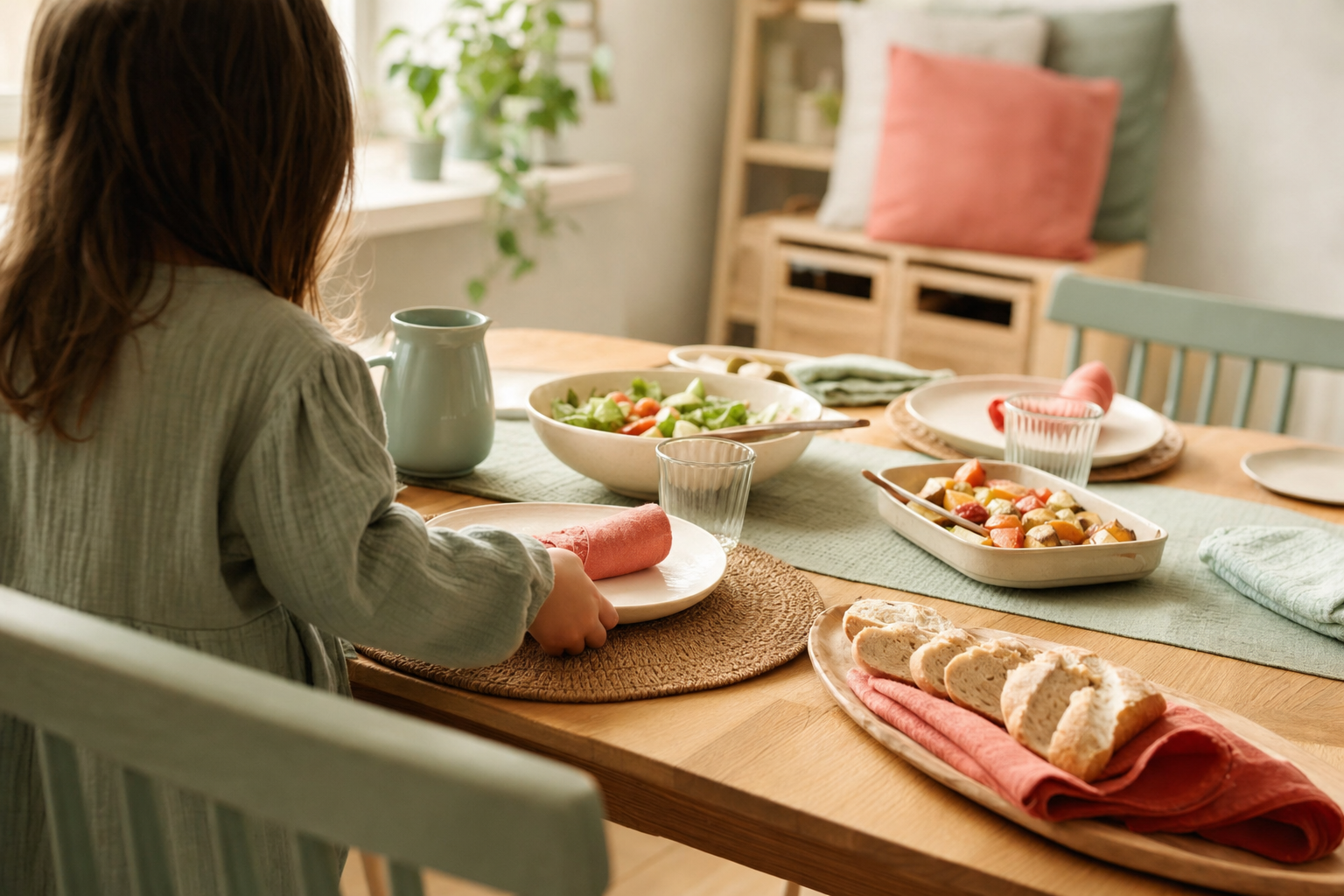
Keeping a family dinner routine going through a busy school year often takes more than good intentions. The version that lasts usually pairs a realistic goal of about three shared meals a week with planned batch cooking, one meal for the whole family, and a weekend breakfast or brunch when weeknights fall apart. The American Academy of Pediatrics’ HealthyChildren guidance links eating together several times a week with real benefits for kids. Below, each decision gets a side-by-side comparison so you can pick the mix that fits your actual week.
Key Takeaways
- Plan for three shared meals: Aiming for at least three family meals a week, including weekend breakfast or brunch, gives kids the benefits research links to eating together while fitting a full school-year schedule.
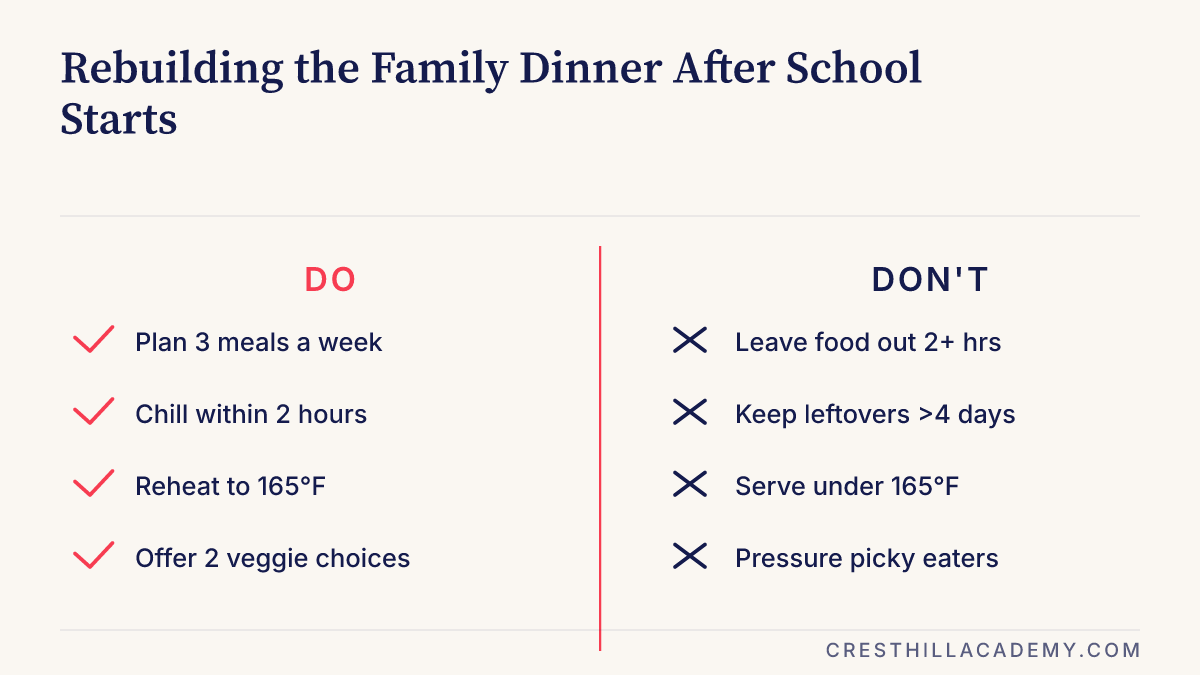
- Batch cooking with safe storage: Batch-cooked dinners stay safe when leftovers are refrigerated in shallow containers within two hours, eaten within three to four days or frozen, and reheated to 165°F.
- Choices between two healthy foods: Offering a choice between two vegetables, such as broccoli or cauliflower, gives a picky eater some control while keeping healthy food on every plate.
Should you aim for dinner together every night or three nights a week?
Three nights a week is the better target for most families, because research ties that frequency to benefits for kids, and it leaves room for late pickups and crowded evenings. Every-night dinner is a lovely ideal, though it tends to be the first plan to crack once fall schedules fill up.
The anchor here comes from the American Academy of Pediatrics. Its parenting site, HealthyChildren.org, notes that kids who eat with their families at least 3 times a week enjoy physical, emotional, social, and academic perks. That same guidance says plainly that you don’t have to eat every meal together. So three is a sensible bar to aim for, and anything beyond that is a bonus you add when life allows. We’d read that as good news for working parents: three is a modest, reachable goal, and a goal that fits real family life is one you’re more likely to keep meeting rather than quietly letting slip.
Why starting small tends to last
Johns Hopkins Medicine makes the case for going even slower at first. Its guidance on family meals acknowledges that expecting everyone at the table every evening may not be realistic at the start. It recommends beginning with one or two days a week, then adding more if and when it feels right. Their stated goal is more family face time and better nutrition, so the whole household feels better mentally and physically.
Predictability matters as much as frequency for a toddler or preschooler. Zero to Three explains that consistent routines, meaning activities that happen at about the same time and in about the same way, give young children comfort and a sense of safety. Knowing what comes next supports security and emotional stability. Here’s our position on what that means for dinner: we’d read it as a reason to favor predictability over frequency, since shared meals that reliably happen at a familiar time and in a familiar way likely matter more to a young child than how many of them a busy family manages each week. Shared meals are also an easy daily place to practice the turn-taking and listening we unpack in our guide to social-emotional learning in early childhood.
In practice, open the calendar you actually have and circle the two evenings with the earliest pickup and the fewest activities. Make those your dinner nights to start. Once they feel automatic, build from there at whatever pace feels manageable, and count a weekend breakfast if that’s the meal that sticks. Dinner also sets the tone for everything after it, which is why a steady meal pairs so well with the habits in creating a calm bedtime routine.
What the evidence doesn’t settle is whether every night beats three nights for a young child. Past a few shared meals a week, whether more nights add more benefit remains an open question. Naming that gap matters, because it frees you from guilt on the nights takeout wins. A realistic goal of three shared meals a week, built up gradually, is the version of family dinner we’re most confident recommending, one that leaves room for the busy weeks.
Weeknight dinner or weekend breakfast: which shared meal fits your schedule?
Either meal counts, so choose the one your schedule can protect week after week. HealthyChildren.org suggests trying breakfast or brunch on the weekends when weeknight dinners don’t always work, which makes a slow Saturday breakfast a full member of your weekly three.
When the late-afternoon slump decides for you
Weeknight dinners have the obvious advantage of frequency: there are five of them, and they sit at a natural pause between work and bed. The trade-off is timing. For many young children, the stretch after pickup can be a hard part of the day, and if your evenings already look like the late-afternoon pattern we describe in our post on September meltdowns, pushing a sit-down meal into that window can turn connection into conflict. Zero to Three notes that moving from one activity to the next can be challenging for toddlers, and the trip from car to kitchen to table is a stack of transitions.
Weekend breakfast flips that equation. Everyone has usually slept, nobody is racing a clock, and a child who unravels at dinnertime may be chatty and curious over pancakes. Slower mornings also suit the kind of shared, low-key time we explore in our ideas for weekend activities with your child. You only get one or two of these meals each week, though, so they work best alongside a couple of weeknight dinners.
On school mornings, a full sit-down breakfast is often unrealistic, and even a few calm minutes together can help; our tear-free morning routine covers how to make weekday mornings smoother without adding pressure. Keep the bar low on content, too. HealthyChildren.org points out that you don’t even have to cook, since sandwiches and fruit or tasty leftovers from earlier in the week will do just fine.
The honest comparison comes down to energy. If your weeknights are calm, protect a couple of dinners; if they’re chaotic, let weekend breakfast or brunch carry more of the load. Choosing the shared meal your family has the energy to enjoy matters more than picking the one that looks most traditional.
Cooking nightly vs batch cooking on the weekend
Nightly cooking and weekend batch cooking each solve a different problem, and the right pick depends on when you have the most energy to make decisions. MyPlate suggests reducing stress at mealtimes by planning out meals before the week starts, and including quick and easy dishes or leftovers on nights that are extra busy.
Cooking every night has real strengths. The food is fresh, you can adjust to whatever the day brought, and there’s a built-in chance for your child to help. MyPlate’s reminder that kids learn by doing is a good argument for letting a preschooler stir, pour, or tear lettuce on a night when you’re not rushed. Its weak spot is the decision itself: figuring out what to make at the moment everyone is tired and hungry is where many weeknight meals go sideways.
A middle path most weeks can hold
Batch cooking moves those decisions to a calmer time. One weekend session spent on a pot of soup, a tray of roasted vegetables, or a big batch of grains turns several weeknights into simple assembly jobs. The trade-off is some weekend time and, without a plan, the risk of leftovers that lose their appeal as the week goes on. If your child is starting a new program this fall, the first weeks already ask a lot of your family, and our comparison of staggered starts versus full-day starts can help you think about how much extra you take on at once.
Our view is that most families do best with a hybrid. Plan the week before it starts, cook in bulk when time allows, and keep some nights flexible for quick dishes, leftovers, or simple sandwich-and-fruit dinners. That mix keeps some freshness and spontaneity while removing the worst of the late-afternoon scramble. Protecting the evening wind-down matters too, since a predictable dinner hour supports the rhythm we cover in rebuilding a sleep routine before daycare starts.
Neither approach wins on its own. Planning ahead, with room for quick meals and leftovers on the busiest nights, gives you the benefits of both nightly cooking and batch cooking without the full stress of either.
Is batch cooking safe for little kids’ meals?
Yes, batch cooking is safe for little kids’ meals when you follow standard leftover rules: refrigerate within two hours, use shallow containers, eat or freeze within a few days, and reheat to 165°F. Those steps come straight from federal food-safety guidance, and they apply to everyone at the table.
Storing, thawing, and reheating
Start with the clock. The USDA’s Two-Hour Rule says all perishable items should be refrigerated within two hours of coming out of the oven or refrigerator; after that, food enters the Danger Zone between 40 and 140 degrees Fahrenheit, where bacteria can multiply quickly. On a busy night, that means packing up leftovers soon after dinner instead of leaving the pot on the stove until the kids are asleep.
Container choice matters as well. FoodSafety.gov recommends storing leftovers in small, shallow containers, because shallow containers help food cool more quickly than large ones. The USDA’s Food Safety and Inspection Service adds that covering leftovers, wrapping them in airtight packaging, or sealing them in containers helps keep bacteria out, retain moisture, and prevent odors from other foods. Wrapped leftovers should go into the refrigerator or freezer immediately for rapid cooling.
Next comes storage time. According to FSIS, leftovers can be kept in the refrigerator for 3 to 4 days or frozen for 3 to 4 months. FoodSafety.gov frames the same idea practically: if you want to keep leftovers longer, freeze them within that four-day window. For a batch-cooking parent, that suggests a simple split, refrigerating what you’ll eat early in the week and freezing the rest right away.
Thawing and reheating are where good intentions slip. Mayo Clinic advises against thawing leftovers on the counter and lists three safe methods: in the microwave, overnight in the refrigerator, or in a leakproof container in cold water. When it’s time to eat, reheat until the food reaches 165°F, measured with a food thermometer, as FSIS directs. Stirring as you reheat helps food heat evenly, per Mayo Clinic, which also notes that slow cookers aren’t suggested for reheating leftovers. In the microwave, FoodSafety.gov suggests covering and rotating the food.
Here’s our position: once those habits are in place, batch cooking is one of the more reliable ways to get a balanced meal in front of a young child on a hard night. Food handling and hand hygiene work as a pair during sniffle season, so our guides to protecting your family during cold and flu season and a September handwashing routine round out the picture. Prompt refrigeration, shallow containers, a few days in the fridge, and reheating to 165°F make batch-cooked dinners a safe choice for the whole family.
One family meal or separate kids’ plates?
One family meal usually works better than separate kids’ plates. Clemson’s Home & Garden Information Center advises serving the same meal to adults and kids, and KidsHealth suggests keeping mealtimes calm by including one food your child already enjoys.
Short-order cooking is tempting for obvious reasons. It ends a standoff quickly, it gets something into your child’s stomach, and it can feel kind after a long day apart. Over time the costs build: you’re cooking two dinners, and your child learns that refusing the family meal produces a preferred one. We’d argue the second effect matters more than the first, because it quietly narrows the menu a child expects to see.
How to build one plate that works for everyone
The shared-meal approach has a simple structure. HealthyChildren.org says there aren’t hard-and-fast rules, but recommends serving at least one vegetable or fruit every time, whether fresh, frozen, or canned with no added sugar. KidsHealth complements that guidance: offer a mix of healthy foods, keep mealtimes calm by serving a food your child enjoys with every meal, and show good habits by eating healthy foods yourself.
At home, that might mean pasta night with plain noodles, sauce on the side, a bowl of peas, and sliced fruit everyone can reach. Serving components separately lets a cautious eater build a plate from familiar parts while still seeing, smelling, and sitting near the full meal. If snacking crept up over the summer, a few adjustments from our post on resetting toddler snack habits can help your child arrive at dinner with an appetite, and our late-summer lunch guide for picky eaters applies the same one-meal logic to packed lunches.
None of this requires a perfect child or a perfect dinner. One shared meal with at least one fruit or vegetable and one familiar food gives every child at the table a safe option and a fresh chance to try something new.
Pressure or choices: which works better with a picky eater?
Offering choices works better than pressuring a picky eater. Clemson’s HGIC suggests asking “Which would you like for dinner, broccoli or cauliflower?” instead of “Do you want broccoli for dinner?”, which gives your child some control while keeping a vegetable on the plate.
Understanding why picky eating happens makes the choice approach easier to stick with. Zero to Three explains that picky eating, an unwillingness to try new or non-favorite foods, usually starts at about two years of age, the same point toddlers begin establishing independence in other parts of their lives. Weight gain, which was rapid over the first two years, also starts to slow, so appetite drops. That’s why Zero to Three describes picky eating as more of a typical milestone than a challenging behavior.
Pressure, whether it’s coaxing, bribing, or an argument over the last bite of chicken, runs straight into that independence. Clemson’s guidance warns that if meals become times for family arguments, a child may learn unhealthy attitudes toward food. Zero to Three frames the division of labor clearly: a parent’s job is to provide a variety of healthy foods in age-appropriate servings at meals and snacks.
Small asks that encourage tasting
Choices aren’t the only tool. KidsHealth suggests asking kids to take just a couple of bites of everything and letting them help choose and prepare foods. Clemson agrees that children get excited about tasting food when they help make meals, and it names easy jobs: adding ingredients, scrubbing veggies, or stirring. Repeated, low-stakes exposure fits how young children learn in general, which we explore in why kids ask to do the same thing again and again, and a new food can become a small experiment, the kind of predict-and-test thinking in your child is a natural scientist.
Here’s how we’d read the evidence together: pressure fights a developmental stage, while choices, a couple of bites, and a job in the kitchen work with it. Offering a picky eater a small choice among healthy foods can honor a toddler’s growing independence while keeping nutritious options on the plate.
Screens on or screens off: what changes at the table?
Turning screens off shifts the table toward conversation and connection. MyPlate recommends turning off the TV and putting away devices so you can unplug, interact, and focus on each other, and Zero to Three’s mealtime tips say the same: turn off screens and talk to one another.
A screen on at dinner can make a hard meal quieter, and some nights that feels like a fair trade. The cost is attention. Kids watching a show aren’t watching you eat broccoli, hearing a sibling’s story, or answering a question about their day, and a parent checking a phone misses the small cues a child gives about being curious, full, or ready to talk.
Turning dinner into conversation
Once the screens are off, keep the topics light. Clemson’s guidance is to talk about fun and happy things while you enjoy each other at family meals. For toddlers and preschoolers, that might mean naming colors on the plate, guessing what a food will taste like, or retelling the best part of the day. Questions that can’t be answered with a yes or no work especially well, and our list of open-ended questions to ask your toddler is a ready-made menu of conversation starters.
We’d argue the table is one of the most underrated language moments in a young child’s day, since it happens often, everyone is sitting close, and there’s a shared topic right in front of you. The same back-and-forth that builds vocabulary in play works at dinner too, as we describe in building language skills through playtime. A screen-free table with happy, open-ended conversation turns an ordinary dinner into daily practice in talking, listening, and taking turns.
Which dinner routine fits your family this September?
The routine that fits is one you can repeat in a hard week: a realistic number of shared meals, a matching cooking style, one meal for everyone, and short sittings for little kids. Each choice above has two workable options, so the plan comes down to matching them to your real life.
Putting the pieces together
Start with frequency. Pick two or three nights, plus a weekend breakfast if weeknights are fragile, and treat three shared meals a week as the target HealthyChildren.org ties to benefits for kids. Then choose a cooking style: nightly if your evenings are calm, batch if they’re hectic, and the hybrid of planning ahead with quick nights built in if you’re somewhere in between.
Next, decide on the plate. Serve one meal to the whole family with at least one fruit or vegetable and one food your child likes, and offer choices between two healthy foods instead of yes-or-no questions. Keep screens off and topics happy.
Two small habits make the routine easier for young children. Zero to Three notes that some parents use a timer or a “5-minute warning” to prepare toddlers for a change in activity, which works well when you’re calling a child in from play to the table. Mealtimes for toddlers and preschoolers, according to Zero to Three’s picky-eating guidance, shouldn’t be longer than 15 to 20 minutes, and children can play nearby while you finish. A short, predictable meal followed by a familiar wind-down, like the one in our post on a September reading ritual for easier school transitions, gives the evening a shape your child can anticipate.
If your child is pushing back on school or daycare this fall, a calm dinner can become one of the steadiest parts of the day, and our guide for when your child doesn’t want to go to school offers more support. Expect to adjust along the way as the seasons and your family’s schedule shift. A family dinner routine built on a few realistic shared meals, safe batch cooking, one meal for everyone, and short screen-free sittings can help carry your family through the school year.
| Fact | Detail |
|---|---|
| Founded | 2010 |
| Locations | 8 New Jersey campuses across East Hanover, Harrison, Hoboken, Lyndhurst, Paramus, and Parsippany-Troy Hills |
| Curriculum | EsteamED Curriculum® (proprietary) |
| Age range served | 6 weeks – 5 years |
| Programs | Infants, Toddlers, Preschool |
| Hours | Monday-Friday, open 7:00 AM-7:30 AM, close 6:00 PM-7:00 PM (varies by campus) |
| Languages introduced | American Sign Language and Spanish at every campus; Mandarin immersion at the Hoboken campuses |
| Tagline | Exceptional Early Education™ |
Frequently Asked Questions
Should you aim for dinner together every night or three nights a week? Three nights a week is the better target for most families, because research ties that frequency to benefits for kids, and it leaves room for late pickups and crowded evenings. Every-night dinner is a lovely ideal, though it tends to be the first plan to crack once fall schedules fill up.
Weeknight dinner or weekend breakfast: which shared meal fits your schedule? Either meal counts, so choose the one your schedule can protect week after week. HealthyChildren.org suggests trying breakfast or brunch on the weekends when weeknight dinners don't always work, which makes a slow Saturday breakfast a full member of your weekly three.
Is batch cooking safe for little kids' meals? Yes, batch cooking is safe for little kids' meals when you follow standard leftover rules: refrigerate within two hours, use shallow containers, eat or freeze within a few days, and reheat to 165°F. Those steps come straight from federal food-safety guidance, and they apply to everyone at the table.
One family meal or separate kids' plates? One family meal usually works better than separate kids' plates. Clemson's Home & Garden Information Center advises serving the same meal to adults and kids, and KidsHealth suggests keeping mealtimes calm by including one food your child already enjoys.
Pressure or choices: which works better with a picky eater? Offering choices works better than pressuring a picky eater. Clemson's HGIC suggests asking "Which would you like for dinner, broccoli or cauliflower?" instead of "Do you want broccoli for dinner?", which gives your child some control while keeping a vegetable on the plate.


