
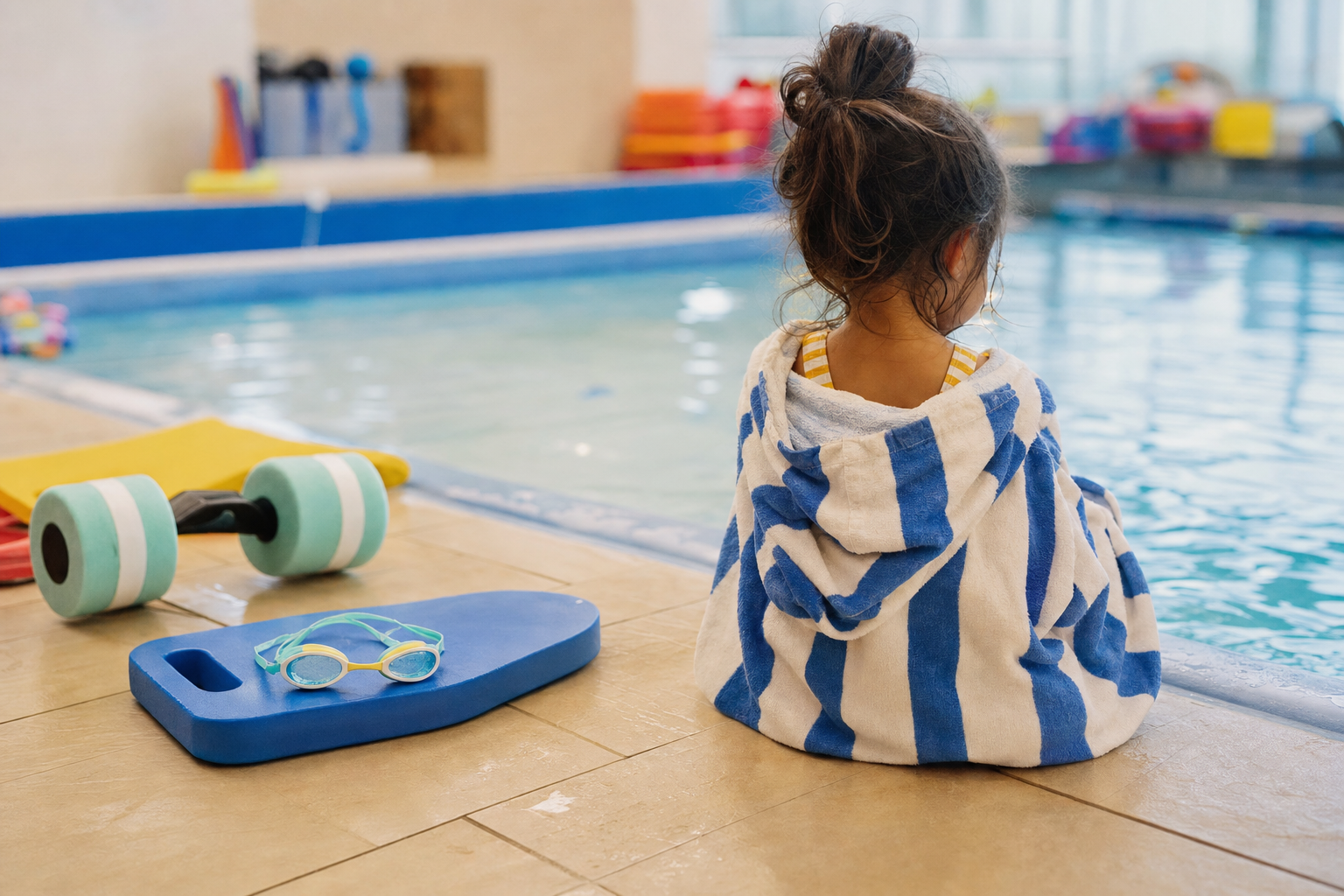
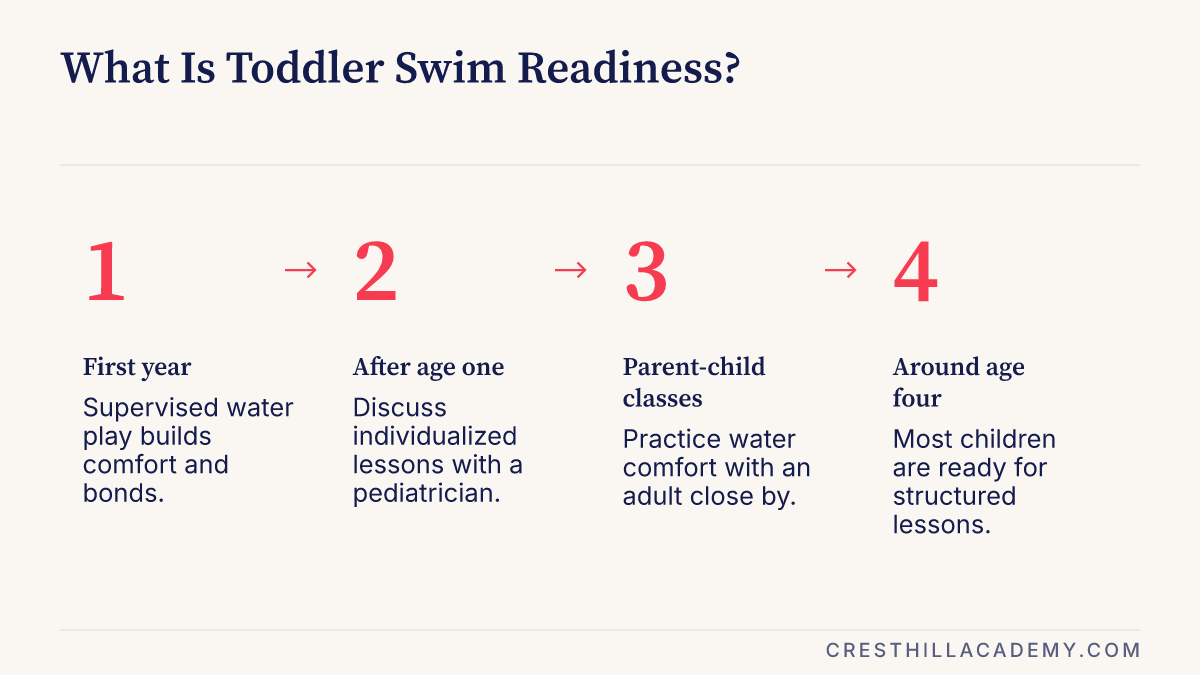
Toddler swim readiness arrives in stages across early childhood. Infants under one are not neurodevelopmentally capable of survival swimming, so their water time is about comfort and closeness. Many children can begin lessons after their first birthday, and by the fourth birthday most are ready for structured instruction. At every stage, an adult stays within arm’s reach and the pool sits behind a locked, four-sided fence. Here is how that arc unfolds, and what to do tonight.
Key Takeaways
- The first year is for supervised water play: Infants under one cannot survival-swim, so early water time is about comfort and bonding under close adult supervision.
- After age one, lessons enter the picture: The AAP supports swim lessons for many children starting after the first birthday, individualized with a pediatrician.
- Most children are lesson-ready by four: By the fourth birthday, most children have the maturity and physical ability for structured swim instruction.
How does water readiness begin in the first year?
Water readiness in the first year is about a baby learning that water can feel safe. Infants under one are neurodevelopmentally unable to perform survival swimming, so no class, method, or marketing promise changes what their bodies and brains can do. The American Academy of Pediatrics is direct on this point.
Read the AAP’s guidance on swim lessons and the message is steady. Skills develop on a timeline you cannot rush. A baby held gently in warm water is building comfort and trust, laying down sensory memory. Those are real gains, even though they are not strokes. There is also a physiological reason to slow down here. Infants who swallow or inhale pool water can develop hyponatremia, a dangerous dilution of blood sodium, which is one more reason submersion drills marketed to babies do more harm than good.
What supervised water play actually looks like
Keep sessions short and warm. Support your baby’s head and chest, sing, pour a little water over their shoulders, and watch their cues. A relaxed baby leans in. When a baby arches and cries, that tension is your signal to stop. You are bonding here. Aim for water near body temperature, roughly the high 80s to low 90s Fahrenheit, because babies lose heat fast and a chilled infant cannot enjoy or learn anything. Ten or fifteen minutes is plenty at this age. The same attentive pacing shows up in how we read a young child’s readiness for any new experience. In our infant rooms, teachers wait for the settled body before introducing anything new, whether that is a texture, a song, or a face.
The developmental logic here mirrors everything else in the first year. Rolling, sitting, and reaching all arrive when the nervous system is ready, and water comfort is no different. Head control, for instance, is a prerequisite most parents forget: a baby who cannot yet hold their head steady has no business being tipped or floated. If you want the broader picture of what unfolds month by month, our guide to development milestones from ages 0 to 5 lays out the sequence. What we would add, from the rug-level view, is that a calm first year in the water buys you an easier second year, because the child associates the pool with your arms rather than with fear. That association is the single most valuable thing you build before age one, and it compounds.
What changes after the first birthday?
After the first birthday, lessons genuinely enter the picture for many children. The AAP now supports swim lessons starting at age one for many kids, a shift that reflects both new drowning research and a better read on toddler development. This is a per-child decision, made with your pediatrician.
The AAP’s drowning-prevention policy statement frames lessons as one layer of protection among several. The evidence behind the shift is worth knowing. A frequently cited case-control study published in 2009 in what is now JAMA Pediatrics found that formal swim lessons were associated with a sharply reduced risk of drowning in children ages one to four, and it was that finding that moved the AAP off its older, more cautious threshold. Readiness after age one rests on emotional maturity, on physical and developmental ability, and on real comfort in the water. A child who melts down at every transition may not be ready even at fifteen months. A settled, curious toddler might be.
Why the timing is individual, not automatic
The reason the AAP says “many children” and not “all children” matters. Toddlers vary enormously in the second year. One is walking confidently and following simple directions; another is still finding their feet and testing every limit. Neither pattern is a problem, and each deserves lessons matched to where the child actually is. A good early-toddler program spends most of its time on skills that look nothing like swimming: entering and exiting the water safely, turning back to a wall, floating on the back, staying calm when a face gets wet.
This is the same developmental jump we see when a child moves from the infant room into the toddler room, and the differences are stark enough that we wrote a whole piece on what changes with age between infant and toddler care. The through-line is capability. A toddler who can hold a cup, point to what they want, and wait a beat before grabbing is a toddler whose self-regulation is coming online. Our toddler teachers read those same cues before handing a child more independence, and swim instructors watch for the identical readiness at the water’s edge. One practical test parents can run: does your toddler tolerate water poured over their head during bath time without a full meltdown? If face contact still triggers panic, a few more weeks of gentle bath play will make the first lesson far more productive.
How do parent-child classes build the foundation?
Parent-child classes are where readiness quietly gets built. Before a child ever takes a solo lesson, these classes teach comfort, breath awareness, and trust through play. The AAP specifically names parent-child classes as a foundation for later swim readiness, and the mechanism is simple: repetition in a safe, joyful setting.
The play is the point. A toddler who blows bubbles on cue, reaches for a floating toy, and lets water touch their face is practicing skills that later become breath control and forward movement. None of it feels like instruction to the child. That is exactly why it works. KidsHealth’s overview of pool safety reinforces that early water experiences should stay positive, because fear learned young is hard to unlearn. Breath control deserves special mention. Blowing bubbles is the toddler-friendly precursor to exhaling underwater, and a child who masters it on land, blowing across warm soup or a pinwheel, walks into the pool with a head start.
Play is the vehicle, not the filler
We think about this the way we think about all early learning. Skills stick when they arrive wrapped in play, encoded through joyful repetition. A song that ends with a gentle dip, a game of “reach the duck,” a count to three before a splash, these build the same neural pathways a formal lesson will use later. Our approach to play-based activities for toddlers rests on the same evidence base, and decades of developmental research, from Vygotsky forward, hold that young children encode new skills most durably when the learning is embedded in play rather than delivered as direct instruction.
Here is our point of view on top of the research. Parent-child classes do double duty that people underrate. They teach the child, yes, but they also teach the parent to read the child’s water cues, to recognize the difference between nervous fussing and real distress. Real distress in the water is often silent and vertical: the child stops making noise, their head tips back, their arms press down instead of waving. In our classrooms we make a habit of naming a child’s body signals out loud as we see them, and parents in these swim classes end up doing the same. That fluency, more than any single skill, is what carries a family safely into the next stage.
Why is the fourth birthday a turning point?
By the fourth birthday, most children are ready for structured swim instruction. This is the age the AAP flags as the point where the majority have the maturity, coordination, and body awareness to learn real strokes and water-safety skills in a formal setting. The pieces that were developing in years one through three finally align.
What changes at four is integration. A four-year-old can usually follow multi-step directions, control their breath on purpose, coordinate arms and legs, and manage the frustration of not getting something right the first time. Those are exactly the capacities a swim lesson demands. The CDC’s drowning-prevention guidance notes that formal lessons reduce drowning risk, and around four is when children can absorb them most efficiently. Drowning still ranks among the leading causes of death for children ages one to four, which is why the agency treats lessons as prevention infrastructure and not merely a summer activity.
This turning point rhymes with everything else happening at four. It is the same window when children show the focus, independence, and social readiness that signal they are ready for more structured learning generally, a pattern we map in our guide to preschool readiness developmental signs. Here is where the rug-level view sharpens the point: the four-year-old who can sit for a story, wait a turn, and try again after a stumble is the same child who thrives in a swim class, because the underlying skill is self-regulation developing on its own timeline. Parents sometimes worry that a child who has not started lessons by four is behind. They are not. A motivated four- or five-year-old often progresses faster than a reluctant two-year-old, precisely because the cognitive scaffolding is finally in place.
What stays constant across every stage?
One truth holds at every age: lessons are a layer of protection that still requires supervision and barriers around it. Drowning is a leading cause of death for children ages one to four, and it happens in seconds, usually in silence. No amount of instruction removes the need for the supervision and barriers that surround it. This is the load-bearing message of this entire post.
The non-negotiables are consistent from infancy through the school years. Pool Safely, the federal water-safety campaign, and Safe Kids both anchor the same short list. Keep it posted where your family swims. The statistics behind these rules are sobering. As Stop Drowning Now reports, most young children who drown are last seen inside the house minutes before, and a large share of these deaths happen during non-swim times when nobody expected the child to be near water at all.
The layers that never change
- A four-sided fence. A four-foot, non-climbable barrier should surround the pool on all sides, with a self-closing, self-latching gate that stays locked. Research shows four-sided isolation fencing cuts drowning risk more than a house wall that leaves the pool open to the back door.
- A dedicated Water Watcher. Designate one adult whose only job is supervision, no phone, no book, no side conversation. Rotate the role every fifteen minutes so attention stays sharp, and hand off a physical token so everyone knows who holds it.
- Arm’s reach. Keep young children and beginner swimmers within arm’s reach, always. This is often called “touch supervision,” and lessons do not change this rule.
- CPR training. Learn infant and child CPR, and keep it current. Seconds matter, and bystander CPR started before paramedics arrive measurably improves outcomes.
These layers work together, which is why safety experts call it a system. A fence buys time if supervision lapses. A Water Watcher catches trouble a fence cannot. CPR bridges the gap until help arrives. Notice what is missing from the list: inflatable arm floaties and pool toys. These give children and parents a false sense of security and can slip off in an instant, which is why safety campaigns steer families toward Coast Guard-approved life jackets when flotation is truly needed. The Water Watcher rule will feel familiar to anyone who has watched a well-run classroom during a busy transition, when one adult’s eyes stay on the children and nothing else. Our teachers hand off that watching role in exactly the same deliberate way, with a word and a nod, so the coverage never quietly drops. Our daycare safety checklist for parents lays out the same layered logic on land. Trained, consistent adults holding New Jersey’s supervision standards are the floor. Everything else builds on that.
How do you match lessons to your own child’s pace?
Match lessons to your child by watching the child’s development and readiness. Every child is different, so the right time to enroll depends on age, development, temperament, and how often your family is around water. A child with a backyard pool or frequent beach days may benefit from earlier lessons than one who swims twice a summer.
Start with your pediatrician. The AAP is explicit that lesson timing should be individualized in conversation with your doctor, who knows your child’s developmental history and any medical considerations, including ear-tube history, seizure conditions, or asthma that could change the plan. Bring specifics: Does your toddler follow simple directions? How do they handle water on their face? Do they recover from frustration or shut down? Those answers matter more than a birthday. And factor in exposure honestly, because more time near water raises the stakes and can move up the timeline.
Vet the program as carefully as the timing. Ask whether instructors are certified through a recognized body, how small the classes are, whether the curriculum includes water-safety skills and not just splashing, and how the pool handles a child who is having a hard day. A quality program never shames a crying toddler into submersion. Comfort-building happens outside lessons too. Splash pads, shallow wading, and warm bath play all extend the positive water experiences that make formal lessons easier when they come. If you are looking for low-pressure ways to build that comfort in the warm months, our roundup of cooling off with toddlers at splash pads is a good place to start. The goal is steady, joyful exposure that keeps water in the “safe and fun” column of your child’s mind.
Questions parents ask as swim readiness develops
Most questions come down to one theme: timing versus safety. Parents want to know when lessons should start and whether lessons make their child safe. The honest answer is that timing is individual and lessons are one protective layer, never a substitute for supervision and barriers. Below are the questions we hear most as families move through the stages.
Look closely and these questions share a single root. Readiness is developmental, so the same signals you watch for in speech, motor skills, and preschool readiness apply at the pool. A child who is regulating, following directions, and enjoying the water is telling you something real. Trust that, and keep the safety layers locked in place regardless of skill level. And remember that regression is normal: a toddler who loved the water in June may protest in August, and that swing usually reflects a passing developmental leap elsewhere that fades as it resolves.
For families building water comfort before lessons begin, low-key outings help. Our parent’s guide to splash pads offers easy, supervised ways to keep water positive between now and that first real lesson.
Frequently Asked Questions
How does water readiness begin in the first year? Water readiness in the first year is about a baby learning that water can feel safe. Infants under one are neurodevelopmentally unable to perform survival swimming, so no class, method, or marketing promise changes what their bodies and brains can do. The American Academy of Pediatrics is direct on this point.
What changes after the first birthday? After the first birthday, lessons genuinely enter the picture for many children. The AAP now supports swim lessons starting at age one for many kids, a shift that reflects both new drowning research and a better read on toddler development. This is a per-child decision, made with your pediatrician.
How do parent-child classes build the foundation? Parent-child classes are where readiness quietly gets built. Before a child ever takes a solo lesson, these classes teach comfort, breath awareness, and trust through play. The AAP specifically names parent-child classes as a foundation for later swim readiness, and the mechanism is simple: repetition in a safe, joyful setting.
Why is the fourth birthday a turning point? By the fourth birthday, most children are ready for structured swim instruction. This is the age the AAP flags as the point where the majority have the maturity, coordination, and body awareness to learn real strokes and water-safety skills in a formal setting. The pieces that were developing in years one through three finally align.
What stays constant across every stage? One truth holds at every age: lessons are a layer of protection that still requires supervision and barriers around it. Drowning is a leading cause of death for children ages one to four, and it happens in seconds, usually in silence.
Related Articles


About Cresthill Blog
This article is published by the Cresthill Blog team, the early-childhood educators and content specialists behind cresthillacademy.com. Cresthill Academy operates licensed daycare and pre-K programs across northern New Jersey, serving families in Hoboken, Harrison, East Hanover, Lyndhurst, Paramus, and Parsippany. Editorial decisions reflect our classroom practice and our reading of current early-childhood research.