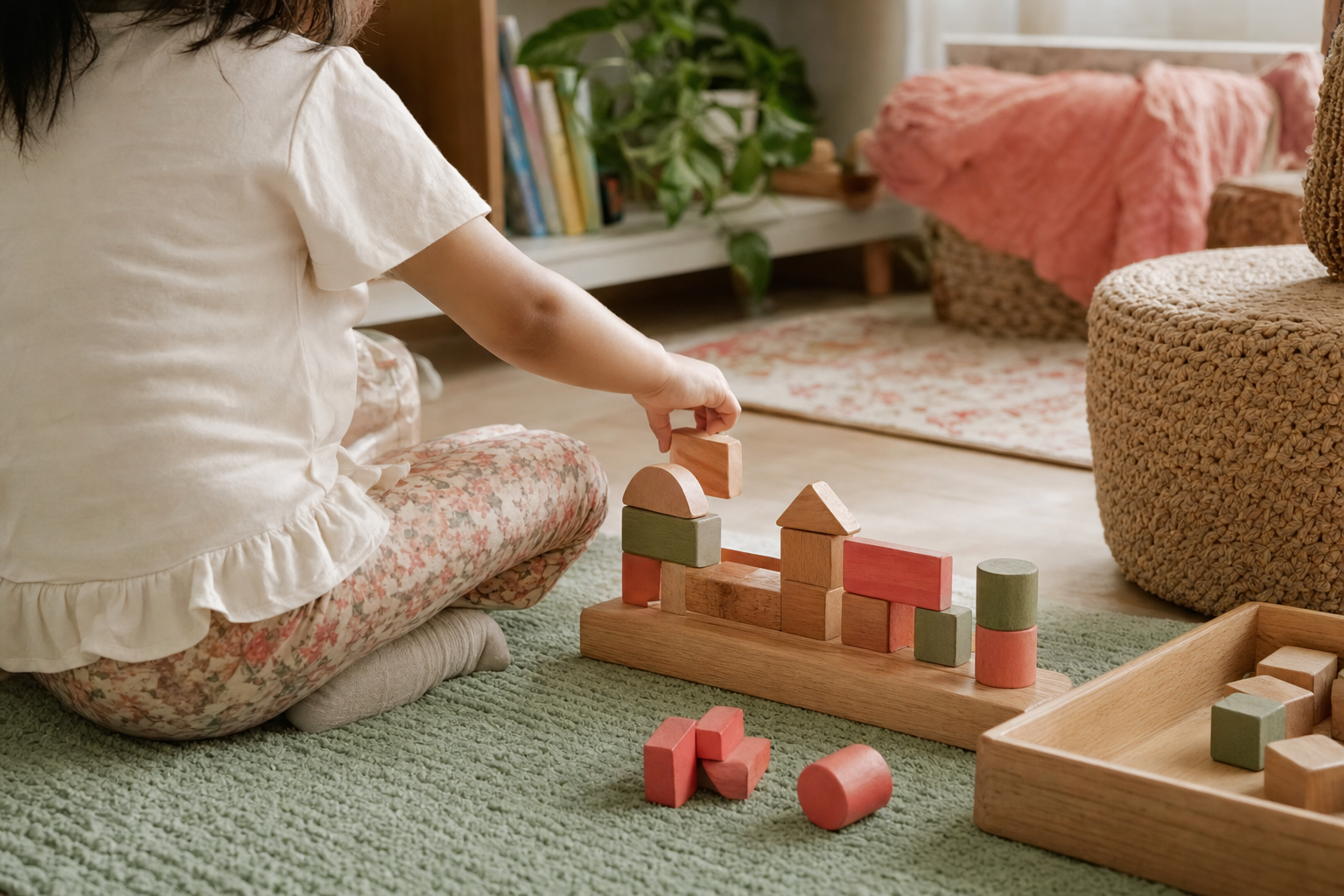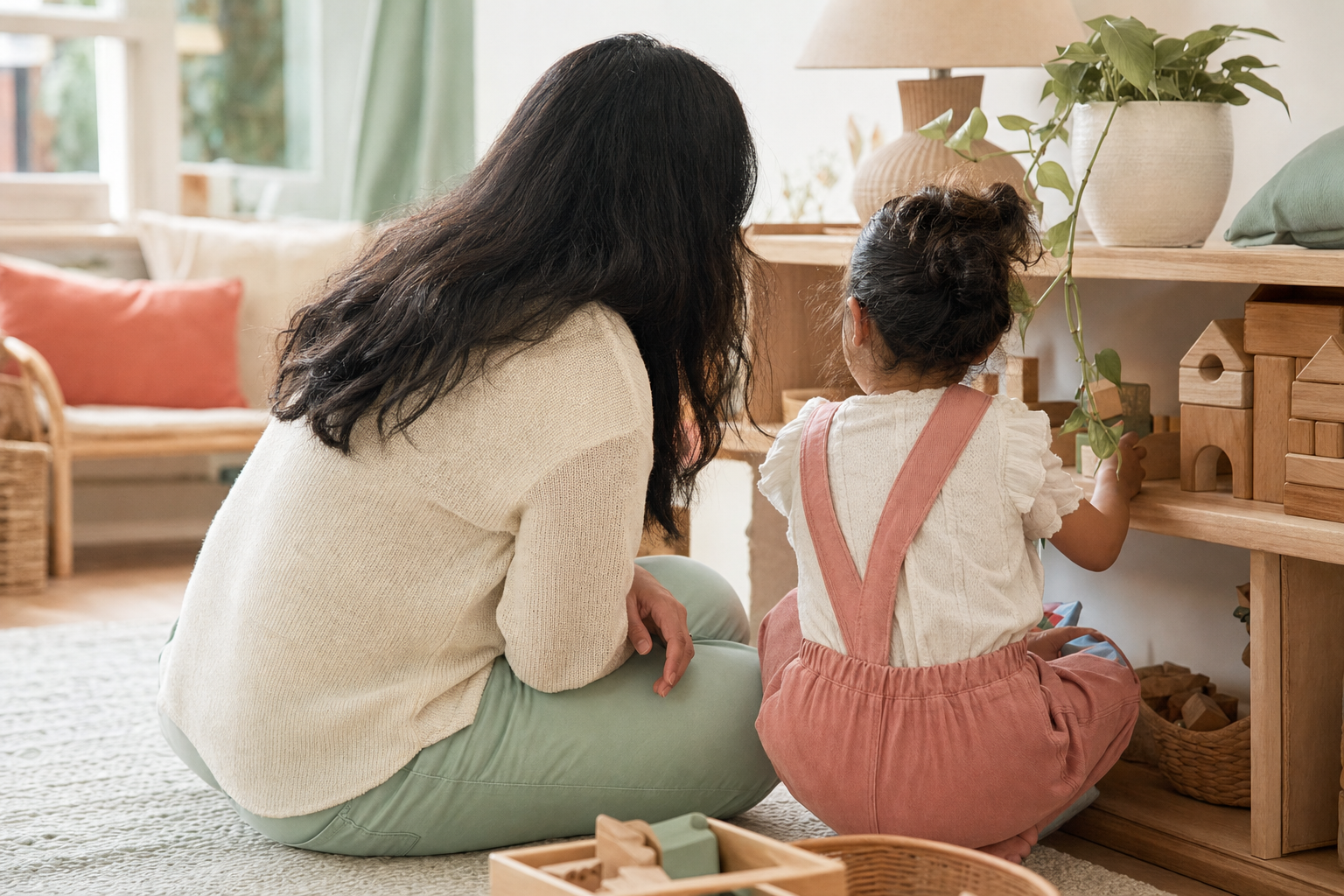
If you’re wondering what to say instead of answering your child’s “why,” start by handing the question back: “What do you think?”, “How could we find out?”, or “Tell me more.” Then wait, listen, and build on whatever your child offers. Researchers at Harvard’s Center on the Developing Child call this kind of back-and-forth “serve and return.” When a question touches safety, a worry, or something your child needs to know right now, give a plain, honest answer first.
Key Takeaways
- Start with 'What do you think?': This one phrase turns a 'why' into a turn your child takes, and waiting quietly for the reply keeps the conversation going.
- Answer safety questions plainly: When a 'why' is about staying safe, a worry, or something your child needs right now, a short honest answer comes first and the wondering can follow.
- Rotate the five CROWD prompts: Dialogic reading groups prompts into completion, recall, open-ended, wh-, and distancing questions, and completion, open-ended, and wh- prompts are the easiest place to start.
Why does my child ask ‘why’ so much?
Your child asks “why” so often because their curiosity is booming, and because every question pulls you into a conversation. Each one is part fact-finding mission, part bid for connection. That connection side matters too, even when the questions come one after another.
Researchers have a name for it. Harvard’s Center describes “serve and return” as responsive back-and-forth exchanges between a young child and a caring adult, a lot like a lively game of tennis. According to the Center, these exchanges support early language and social skills that your child will build more complex thinking on later. A “why” is a serve. Your reply is the return.
What the questions are really asking for
Think about the questions that pile up on a long car ride: why is the sky blue, why do dogs bark, why can’t we go faster. Most of them are after something simpler than a full scientific answer. Your child wants to know you heard, that asking was worth it, and that you’ll keep playing. So your attention counts for a lot. A full explanation often counts for less than you’d expect.
Repetition is part of it too. If the same “why” keeps coming back, it’s in good company with the repeated book and the repeated game, which we unpack in why kids ask to do the same thing over and over. Familiar questions let your child practice the exchange itself, and practice is how fluency grows.
Here’s our position. We read the serve-and-return evidence as a strong reason to lean into the why phase, and our guide to how wonder leads to lifelong learning follows that thread further. Every “why” is a small invitation to trade turns. Take enough of them and you’re building language and connection at once.
Is it okay to skip answering every ‘why’?
Yes, it’s okay. Research on shared reading suggests that handing the question back can help your child’s language grow. When you hold off on the instant answer, your child gets the speaking turn, and that’s where their own words and ideas get a workout.
Dialogic reading gives the clearest evidence. The What Works Clearinghouse describes it as an interactive picture-book practice where adult and child switch roles: your child learns to become the storyteller, and you act as an active listener and questioner. That’s the same switch you make when you answer a “why” with “What do you think?”
So why would talking more help? Here’s how we’d put the mechanism. An open question like “What do you think?” gives your child room to reach for the words they have and to try putting an idea into speech of their own. Then comes your part of the exchange. Reading Rockets’ PEER steps and ASHA’s “extensions” (more on both below) have you expand on what your child said, so they hear their own idea handed back a little fuller. Their attempt, then your slightly richer version: that loop is where we think the growth comes from.
What the research found
When federal reviewers examined the studies, four met WWC evidence standards and one met them with reservations. Those five studies included over 300 preschool children, most from economically disadvantaged families. Reviewers found positive effects on oral language and no discernible effects on phonological processing, the sound-awareness side of early reading.
That’s an older review, so it’s fair to ask whether it still holds. We think it does, because Reading Rockets, cited further down, still describes the same payoff for oral language. Here’s how we’d read it honestly. The evidence comes from a structured book-reading practice, so it speaks most directly to story time. In that setting, giving a preschooler the talking role, with you listening and asking questions, has solid support. It’s a modest claim, and we think it’s the honest one. And it’s still a good reason to let some questions sit unanswered for a beat.
Handing back questions also sits close to inquiry-based learning, where children investigate their own questions. If books are already part of your routine, a steady reading ritual is a natural place to try it first.
What exactly should I say instead?
Say something that hands the thinking back: “What do you think?”, “How could we find out?”, “What did you notice?”, or “Tell me more about that.” Each one invites a full answer. None can be closed with a quick yes or no, so your child keeps talking.
Speech-language pathologists writing in The ASHA Leader recommend open-ended questions, since questions that need more than a “yes” or “no” encourage children to share their thoughts and ideas freely. A “why” already starts open. Your reply can keep it that way.
A phrase bank for the why phase
Keep a few of these ready, and rotate them so they don’t start sounding like a script:
- “What do you think?” Works for nearly any why, and it gives your child the first turn.
- “How could we find out?” Turns a question into a small plan: look it up together, try it, or ask someone who knows.
- “What did you notice?” Pulls attention back to things your child can see, hear, or touch.
- “Tell me more about that.” Invites your child to keep going with an unfinished idea, without judging it.
- “What would happen if…?” Invites a prediction you can test together when it’s safe.
- “Hmm, I wonder too.” Shows that grown-ups wonder as well, and that not knowing is fine.
Tone matters as much as wording. Said with curiosity, and without hurry, “What do you think?” sounds like an invitation. Said flatly while you scroll your phone, those same words can feel like a brush-off, and kids tend to pick up on that.
“How could we find out?” deserves extra love, because it teaches a habit you lean on as an adult all the time. The answer might be a library book, a quick experiment with ice cubes in the sink, or a call to Grandma. One next step you can take together is plenty.
For a longer list built around younger kids, see our guide to open-ended questions to ask your toddler. And if one question keeps your child hooked, turning one question into a week of play at home shows how to stretch it out.
Of all of them, “What do you think?” is the one we’d recommend most confidently. It works almost anywhere and asks nothing of you but patience.
How long should I wait for my child to answer?
Wait longer than feels natural, and let your child’s face and body tell you when they’re still thinking. Serve-and-return guidance treats that waiting as essential. Your patience is the only timer you need.
In its five-step guide to serve and return for parents, the Center says waiting is crucial because children need time, and waiting helps keep the turns going. That guidance doesn’t name a set number of seconds, and we think that’s the right call. Younger and older preschoolers process at different speeds, and so does one child on a fresh morning versus a tired evening.
How to make the pause feel comfortable
Silence can feel awkward to grown-ups, so give the pause something to hold. Lean in, raise your eyebrows, or repeat the question softly. You’ll often spot signs your child is still working: looking up, fiddling with a toy, starting a sentence and stopping. If the pause slides into confusion, rephrase, or offer two ideas to choose between.
That patient pause sits at the heart of responsive caregiving, which we look at more closely in our post on responsive caregiving. And play hands you endless low-stakes chances to practice, as our guide to building language skills during playtime explains.
What do I do with a silly or wrong answer?
Treat it as a starting point. Repeat what your child said, then add a detail or a gentle question that moves the idea forward. Correction can come later, folded into the conversation, so your child keeps the confidence to answer next time.
Dialogic reading has a tool for this. Reading Rockets describes the PEER sequence (prompt, evaluate, expand, and repeat) as a way to encourage deeper responses. You prompt, your child answers, and then you evaluate, expand, and repeat the prompt so your child can try the fuller version.
Repeat, add on, and keep it going
ASHA’s activities to encourage speech and language development line up neatly: repeat what your child says to show you understand, and add on to what they say. The ASHA Leader calls this using extensions, which means adding an idea or a bit more complexity to what your child said. Both keep your child talking while you quietly upgrade the language.
Say a question about rain gets the answer “because the clouds are crying.” You might say, “The clouds are crying? What a fun way to picture it. Rain does fall from clouds. What do you think is inside a cloud?” That reply keeps the image, adds a true fact, and hands back a fresh question.
Imaginative answers are worth protecting. A wildly wrong explanation can be pretend thinking at work, and ASHA’s guidance on communication milestones for ages 3 to 4 encourages dress-up and role-playing because they help children learn social skills and how to tell stories. For more, read why pretend play matters and how to raise a creative child.
Our view is that accuracy can wait a minute, while confidence is harder to rebuild. When a factual mistake matters, model the right version warmly: “Some people think that, and here’s what scientists found.” A flat “No, that’s wrong” tends to shut the door on the next answer.

How do I use this during story time?
Rotate through five prompt types, remembered by the word CROWD: completion, recall, open-ended, wh- questions, and distancing. Start with the easier ones, then let your child do more of the telling as a book gets familiar.
According to Reading Rockets, completion prompts leave a blank at the end of a sentence for your child to fill in, and they’re usually used in books with rhyme or repeated phrases. Their example: “I think I’d be a glossy cat. A little plump but not too ____,” with your child supplying “fat.” Reading Rockets says completion prompts give children information about how language is structured, which is critical to later reading.
The five CROWD prompts, in plain terms
- Completion. Leave the last word of a rhyme or repeated line blank.
- Recall. Ask about a book you’ve already read: “Can you tell me what happened to the little blue engine in this story?”
- Open-ended. Point at a busy picture and say, “Tell me what’s happening here.”
- Wh- questions. Ask what, where, who, or why about the pictures. “What’s this?” works well for younger listeners.
- Distancing. Connect the story to your child’s own life, like a trip you took or a pet you know.
Pace matters. Reading Rockets notes that distancing and recall prompts are more difficult for children than completion, open-ended, and wh- prompts, so lean on completion, open-ended, and wh- prompts with younger preschoolers. Add distancing and recall as your child grows into them, and back off when a question gets a blank stare.
The payoff reaches past vocabulary. Reading Rockets reports that when dialogic reading is well planned and carried out, research suggests it can be particularly effective at improving print awareness, oral language, and comprehension. ASHA adds a freeing permission for tired parents: you can skip words and just talk about the pictures.
Conversation can keep going after the last page, too. A drawing or a coloring page of a favorite scene can bring back recall questions the next day, and a well-loved book makes a natural anchor for rainy-day play at home. If we had to pick one habit from this section, it’s re-reading the same book, because each pass lets your child take over a little more of the telling.
When should I just give my child the answer?
Give a direct, honest answer whenever the “why” is about safety, a worry, something your child needs to know right now, or a word they don’t understand. Wondering can come afterward, once your child has what they need to feel safe and understood.
Safety questions come first. If a “why” is about something that could hurt your child, a short, calm, truthful reason is the kind reply. Handing that one back would leave your child guessing about something that matters. For the safety steps themselves, like what to keep out of reach at home, your pediatrician is the right guide. You can still invite wondering later, once everyone’s safe: “What else do you think we should be careful around?”
Worries, need-to-know moments, and new words
Worried questions deserve the same plainness. When your child asks why a parent is leaving on a trip or why a pet is sick, the real question is often whether they’re safe and cared for. Answer that part first, briefly, truthfully, and warmly. The bigger talk about feelings can follow, which we explore in asking questions about feelings.
Need-to-know questions get a straight answer too. If you’re rushing out the door and your child asks why they need shoes, “Because we’re leaving now” is the kind reply. Save “What do you think?” for a calmer moment when there’s room to explore.
New words are a special case. The ASHA Leader suggests that when you hit a new word while reading, you stop the story, tell your child what it means, and use it in a sentence that connects to their own life. Since it takes many exposures to a word before it becomes part of a child’s vocabulary, keep using it in the days that follow. Feelings words work the same way, as our guide to building emotional vocabulary shows.
We’d count a direct answer as part of the same habit. Responsive adults match their reply to what a child needs in the moment, and a plain answer to a scary question builds the trust that makes your next “What do you think?” feel like a real invitation.
What if my child gets frustrated and says ‘Just tell me’?
Give them the answer, warmly. “Just tell me” is your child’s way of saying they’ve hit their limit for puzzling right now. You can offer the wondering again another time, when they’ve got more energy for it.
Frustration is information. When kids are tired, hungry, overstimulated, or upset, they have less room for thinking out loud, and a late-afternoon question can land very differently from a relaxed weekend-morning one. If the end of the day tends to fall apart, the end-of-day crash may be part of the picture.
Why a direct answer keeps the connection strong
Responsiveness is the heart of serve and return. The Center on the Developing Child warns that when an adult’s responses are inconsistent, harmful, or simply absent, developing brain architecture may be disrupted. One unanswered question won’t do that, of course. Still, the principle points somewhere clear: follow your child’s cue, and when the cue says “help,” help.
Pay attention to what kind of frustration you’re seeing, too. Mild annoyance at a puzzle is different from a full meltdown, and our guide to telling a tantrum from a sensory meltdown can help with the bigger storms. For everyday frustration, try a middle path: give the answer, then add one small hook, like “Want to look at pictures of it later?”
Our honest read of the evidence is that the overall habit matters more than any single exchange. So when your frustrated child asks for the answer, hand it over warmly, and the door stays open for wondering another day.
What if my child isn’t asking questions yet?
Start by talking about what your child sees and does, then play simple question games that make asking feel fun. Younger or quieter kids often build up to “why” gradually, by naming things, picking between choices, and laughing at silly yes-no questions with you.
Naming comes first. The Center on the Developing Child notes that naming what a young child is seeing, doing, or feeling helps make important language connections, even before they can talk or understand words. “You found a red leaf. Listen, it’s crunchy!” is serve and return in its simplest form.
Question games to try at home
ASHA’s tips for parents and its guidance for ages 3 to 4 suggest a few games that work well here:
- The yes-no game. Ask silly questions like “Are you Marty?” or “Can a pig fly?” and enjoy the giggles.
- Choice questions. Offer two options, such as “Do you want an apple or an orange?”
- Try to fool me. Have your child make up questions to try to fool you, and pretend some of them work.
- Picture talk. Show photos of familiar people and places, then talk about who they are and what happened.
The fooling game is our favorite of the bunch, because it hands your child the questioner’s role, the same switch dialogic reading is built on. Getting to stump a grown-up, even by pretend, shows your child that asking questions is powerful and fun.
Every child develops on their own timeline. ASHA reminds parents that each child develops uniquely, even within the same family, and may meet milestones earlier or later than others. If your child isn’t meeting many milestones for their age range, ASHA points families to its ProFind directory to find a certified audiologist or speech-language pathologist for an assessment. For a broader look, see developmental signs of preschool readiness and play-based learning for 3-year-olds. A quiet child who hears their world named, and gets invited into playful question games, is already practicing the back-and-forth that later “why” questions grow from.
| Fact | Detail |
|---|---|
| Founded | 2010 |
| Locations | 8 New Jersey campuses across East Hanover, Harrison, Hoboken, Lyndhurst, Paramus, and Parsippany-Troy Hills |
| Curriculum | EsteamED Curriculum® (proprietary) |
| Age range served | 6 weeks – 5 years |
| Programs | Infants, Toddlers, Preschool |
| Hours | Monday-Friday, open 7:00 AM-7:30 AM, close 6:00 PM-7:00 PM (varies by campus) |
| Languages introduced | American Sign Language and Spanish at every campus; Mandarin immersion at the Hoboken campuses |
| Tagline | Exceptional Early Education™ |
Frequently Asked Questions
Why does my child ask 'why' so much? Your child asks "why" so often because their curiosity is booming, and because every question pulls you into a conversation. Each one is part fact-finding mission, part bid for connection. That connection side matters too, even when the questions come one after another.
Is it okay to skip answering every 'why'? Yes, it's okay. Research on shared reading suggests that handing the question back can help your child's language grow. When you hold off on the instant answer, your child gets the speaking turn, and that's where their own words and ideas get a workout.
What exactly should I say instead? Say something that hands the thinking back: "What do you think?", "How could we find out?", "What did you notice?", or "Tell me more about that." Each one invites a full answer. None can be closed with a quick yes or no, so your child keeps talking.
How long should I wait for my child to answer? Wait longer than feels natural, and let your child's face and body tell you when they're still thinking. Serve-and-return guidance treats that waiting as essential. Your patience is the only timer you need.
What do I do with a silly or wrong answer? Treat it as a starting point. Repeat what your child said, then add a detail or a gentle question that moves the idea forward. Correction can come later, folded into the conversation, so your child keeps the confidence to answer next time.